Search This Blog

Showing posts with label Robert Sheckley. Show all posts

Tuesday, February 4, 2025

"The Life of Anybody" by Robert Sheckley

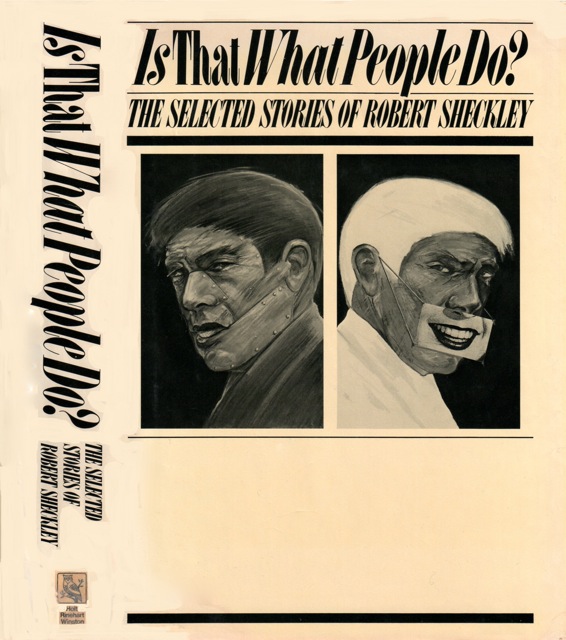
https://www.isfdb.org/wiki/images/8/81/ITWPDO19XX.jpg

First appeared in Sheckley's collection, Is That What People Do?, reprinted by Brian Attebery, Ursula K. Le Guin, Stefan Dziemianowicz, Martin H. Greenberg, Robert Weinberg.

Summary:

Sometime in the near future, people will have TV cameras show up in your living room. You have to be natural or they'll cut away. Better to have bad ratings than none at all. Nobody wants people acting differently than they normally would.

Discussion (Spoilers):

The couple know they are boring, so they spice up their lives in case the cameras come calling again. 

Sheckley had already predicted reality TV before most writers, but here the speculation is that we are actually boring, which is sort of interesting. The shows people watch are more interesting than most people's lives.

However, to become interesting, people would have to fake their lives, which is what we get from most reality TV--people behaving unnaturally to create drama that might get people watching your reality show.

For so short a story, the tale accomplishes much.

I am going through the Norton anthology, story by story, to get a sense for the modus operandi. They seem to be seeking shorter works, provocative works, and possibly works that present gender in a certain manner. There is no particular gender issue at play except maybe the wife chooses not to stir up marital strife for the sake of ratings.

But Sheckley has had better stories than this, so it's odd that this one is selected. Maybe this is the academic aspect, allowing professors to select this among other TV tropes.

The other possibility is that stories were selected to make them easier for non-SF readers; however, you'd think that a course in SF would be more interested in making a splash as opposed to easing people into the waters (especially by 1960-90). When this was published in 1993, most readers would have already been exposed to far stranger SF on TV and movies.

Sunday, February 12, 2023

The Unsung Genius of Douglas Adams

The Restaurant at the End of the Universe - Wikipedia

"[H]e had proved conclusively that if life is going to exist in a Universe of this size, then the one thing it cannot afford to have is a sense of proportion." -- The Restaurant at the End of the Universe

Rereading Douglas Adams for the first time since I was a kid when I was mostly amused if not exactly wowed, I see his work from a different angle. It must have been that Adams did not have a talent for certain writerly crafts, so that I preferred comedic narratives by Robert Sheckley. But Adams was brilliant at other, uncommon narrative delights. 

This is a case in point. He stitches together different anecdotes, some brief, some elaborate, woven as characters move from point A to point B. I don't want to spoil it for those who hate spoilers, so skip the next paragraph if you don't want this tiny moment ruined. 

An elaborate metaphor is slowly built up and executed, metaphorically and literally, having to do with a device that contains the entire universe in a tiny thing--say, a fairy cake--so that when one experiences it, one is annihilated. However, one character manages to survive where everyone else died. He exits, worldview confirmed, eating the cake.  

Take the following metaphor he sets up as being the place where this unhappy device was placed:

 “Many years ago this was a thriving, happy planet—people, cities, shops, a normal world. Except that on the high streets of these cities there were slightly more shoe shops than one might have thought necessary. And slowly, insidiously, the numbers of these shoe shops were increasing. It’s a well-known economic phenomenon but tragic to see it in operation, for the more shoe shops there were, the more shoes they had to make and the worse and more unwearable they became. And the worse they were to wear, the more people had to buy to keep themselves shod, and the more the shops proliferated, until the whole economy of the place passed what I believe is termed the Shoe Event Horizon, and it became no longer economically possible to build anything other than shoe shops. Result—collapse, ruin and famine. Most of the population died out. Those few who had the right kind of genetic instability mutated into birds—you’ve seen one of them—who cursed their feet, cursed the ground and vowed that none should walk on it again, Unhappy lot. Come, I must take you to the Vortex.”

We think, "Ah, ha! That's why this device was created on this planet!"

But Adams pulls the rug out from under us as it was built elsewhere and placed on the planet because it was empty. That doesn't mean the anecdotes aren't connected, but he craftily shifts these anecdotes around. It's a game of three-card monte, where the cards or anecdotes are constantly shuffled around to keep you on your toes.

Monday, September 15, 2014

New and reduced ebook lunches (updated)

Writers of the Future Volume 30: 
Orson Scott Card, Mike Resnick, Robert Silverberg, Val Lindahn, Terry Madden, Amanda E. Forrest, Anaea Lay, K.C. Norton, Randy Henderson, Liz Colter, Leena Likitalo, Shauna O'meara, Paul Eckheart, Megan E. O'Keefe, Oleg Kazantsev, C. Stuart Hardwick, Timothy Jordan, 
$0.99
A great deal. See detailed reviews of stories here. I did a short overview at SF Site.

The Halloween Man: 
A Supernatural Thriller 
by Douglas Clegg 
$0.99

THE MASK and OLD HANDS: 
DOUBLE FEATURE STORIES 
Billie Sue Mosiman 
$0.99 

The Best Horror of the Year: 4 
by Ellen Datlow 
$1.99 

A bunch of SF "Cops and Robbers" books 
from Walter Mosley, Robert Sheckley, William Shatner, John Jakes, John Barnes, William C. Dietz, George Alec Effinger, Greg Bear, Fritz Leiber 
$1.99-3.99

Coming Soon Enough: 
Six Tales of Technology's Future 
Nancy Kress, Greg Egan, Brenda Cooper, Geoffrey Landis, Mary Robinette Kowal, Cheryl Rydbom 
$1.99
big chapbook of contemporary SF

The Millennium Express 
Robert Silverberg 
$2.99
I love these, massive tomes.

View Of A Remote Country: 
Collected short stories SF & fantasy 
Karen Traviss 
$3.99

The Human Equations 
Dave Creek 
$3.99
Analog author
Note: This may be a repackaging of earlier ebooks, so check that you don't have these stories already.  The author states that three of the stories are original (none of the stories replicate ebooks now available unless you bought the earlier ebooks).

Racers of the Night: 
Science Fiction Stories 
by Brad R. Torgersen 
$4.99

Burnt Black Suns: 
A Collection of Weird Tales 
by Simon Strantzas 
$6.00

Academic Exercises 
by K. J. Parker 
$6.99 

Beautiful Blood 
by Lucius Shepard 
$6.99

Discoverability: 
A WMG Writers' Guide 
Kristine Kathryn Rusch 
$7.99

Tuesday, April 1, 2014

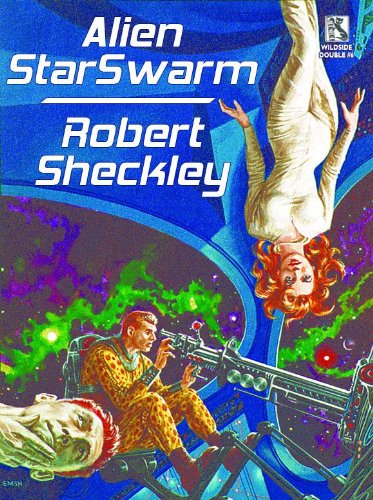
Robert Sheckley: The Art of Humor: Alien StarSwarm

Robert Sheckley is one of the premier humorists in the field.  In his heyday of the 50s and 60s, he was considered simply one of the best.  Jonathan Lethem edited Sheckley's last collection, picking mostly from this era.  However, up until the end, Sheckley was still doing good work, it didn't have the same intensity.  I suspect he had the feeling it needed to remain solely in the speculative field.  Whereas, meanwhile, when given liberty to dabble into more mundane fields while remaining speculative, from time to time, he'd draw from a deeper well of potent emotions.  One story in particular, "Privilege of Age", has an older man is dealing with life in the nursing home.  The humor was low-key, but the emotion packed a wallop.  It first appeared in BigNews, which didn't publish any fiction but Sheckley's.  It's unfortunate editors didn't milk more of this ilk from Sheckley while they could.

Alien StarSwarm is from his later years (1990).  He's still humorous, but not at the same intensity as his early years.  But it has sharp potential.  The set up is that young adults are the captains of starships. The sets up an effective jab at Orson Scott Card's Ender's Game or maybe at the military in general.  So a good question ask about your jokes:  Does this serve a larger purpose?

Descriptions can make effective humor, especially in contrast.  If you have a robot, maybe you'd expect a somber if dynamic, possibly bombastically enthusiastic comparison, as is prone in the sense-of-wonder field.  Instead we get:
"The spider robot waved two tentacles....  He had a body mass about the size and shape of an aluminum beer keg."
Finally, names themselves can be funny.  The enemy is a group of aliens called the Balderdash--not just because it means "senseless talk or writing" but the sounds themselves are funny.  But Sheckley doesn't stop here.  He plays on their name a few times over, heightening not just humor but also meaning, which makes for some of the novella's best humor.

Monday, July 8, 2013

The Idea of Ideas and IO9's interest in Avatar

From the article titles alone, IO9 appears to like Avatar with a desire to have it shell out money to certain parties.


The authors seem semi-unbiased--Charlie Jane Anders appeared to place little stock in the claims in the comment section: "you could easily do a list like this for Star Wars. It's just funny how eager people have been to point out what sources Avatar 'ripped off.' "  But the titles as a group do accidentally lead us to the subtext that Cameron is guilty.

This brings up a slew of questions:  Where's the demarcation?  What is plagiarism?  What's coincidence?  What's homage?  What's wrestling with other people's ideas?  The waters get murky because if you've studied genre history and/or studied with James Gunn, you learn authors actually responded to one another's ideas.  For example, Tom Godwin's "The Cold Equations" still has writers arguing with him.  As does Robert Heinlein's Starship Troopers, which has some of the biggest names in the business respond:   Joe Haldeman, Orson Scott Card, and John Scalzi.

With Robert Sheckley, I discussed the similarities between Stephen King's Running Man and Sheckley's "The Prize of Peril".  Sheckley said he had called up King and asked about that.  King admitted he'd read the story and admired it, but it had been awhile.  Essentially, grist for the mill.  Sheckley accepted the answer.  What a generous heart that man had.

Most likely the articles are intended to provoke thought and discussion although I can't help but feel some sympathy for the artist and wonder what's next for art, especially as copyrights keep getting extended indefinitely.

Thursday, May 30, 2013

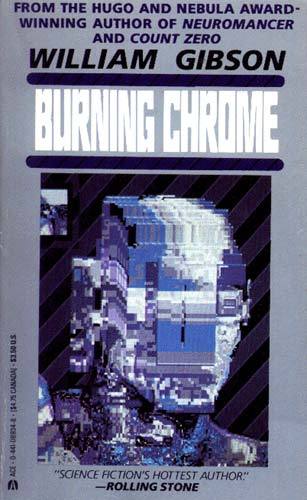
"Johnny Mnemonic" by William Gibson

This is post #500.


Nominated for the Nebula and Locus Poll awards, this originally appeared in Ben Bova and Robert Sheckley's Omni and reprinted in Joe Haldeman's Nebula Awards anthology, two retrospective field anthologies by David Hartwell, and the recent Victoria Blake anthology, Cyberpunk, among others.  After Neuromancer, it's arguably most representative of cyberpunk and possibly the reason it leads off the collection.  Both works feature Molly Millions, prototypical futuristic hired gun and bad -ss.*

Johnny Mnemonic has been carrying Ralfi's data in his head implants, but Ralfi was overdue, so they meet.  Ralfi had a bodyguard and Johnny a shotgun, but Ralfi has a neural disruptor, incapacitating Johnny.  Body-modified Molly drops in and offers her services to the highest bidder, which is Johnny.  She takes care of the bodyguard, and they exit.

Only Ralfi has the password to Johnny's data, but a drug-addicted, cyborg dolphin can access it.  Because they leave behind information wherever they go, Molly and Johnny hook up with the Lo Teks.  They meet an assassin.

Interesting mix of antiquated (microfiche) and futuristic technology (body modification for weapons and information storage).  It's prescient in its assessment of the necessity and ubiquity of information--the impossibility of hiding yourself, pieces of yourself dot along a trail of information.

* My current position does not allow me to write this word--at least I'd rather chance it.

Wednesday, May 29, 2013

"Fragments of a Hologram Rose" by William Gibson


This originally appeared in Unearth, a magazine for beginning writers--one that initially housed many major authors such as James Blaylock.  Parker moves through his dystopian world, being an indentured servant, but escaping from this without a notion as to why.  Parker almost but never recognizes his situation.  That's it.  A character shows us our future American dystopia.   Well written on a sentence level--the story's strength--it doesn't rise above it's parts.  Interesting from a Gibson-completist perspective and how Gibson's work gained incredible strength only four short years later with "The Gernsback Continuum" which appeared in Terry Carr's admired anthology series, Universe, and two stories in the illustrious Omni magazine under the editorship of Ben Bova, Robert Sheckley, Ellen Datlow: " Johnny Mnemonic" and "Hinterlands".  The former was nominated for a Nebula, both for the Locus Poll Award.

Wednesday, December 12, 2012

Most popular posts


Most popular posts (% based on the most popular)

100%
"Girl" by Jamaica Kincaid  
64%
"Warm" by Robert Sheckley 
31% (% based on two posts, forgetting I'd written the earlier one; otherwise Silverberg's would come before)
"The Sun God at Dawn, Rising from a Lotus Blossom" by Andrea Kail (earlier, more popular post 
26%
"Good News from the Vatican" by Robert Silverberg 
20% (% based on two posts, forgetting I'd written the earlier one)
"The Stone Cipher" by Tony Pi (later, less popular post
18%
"Day Million" by Frederik Pohl 
7%
"Life in Steam" by Gra Linnaea
"They're Made out of Meat" by Terry Bisson

Number Stopping by:
The first year was 100/month
The second 150/month
The third 200/month
Since July, it's 700/month

Visitors most often come from:
United States
Russia
Germany
Canada
France
United Kingdom
Philippines
Ukraine
Netherlands
India

Wednesday, December 28, 2011

Thumb-wrestling Cage Match--Rudy Rucker vs. Robert Sheckley

These two authors share much in common: both have relaxed styles, a feeling of spontaneous invention at novel lengths, a penchant for humor derived by putting humans in awkward and bizarre scenarios.

They do differ in literary approach, however. While Rucker's characters tend to feel more fleshed out, Sheckley's emphasis on examining the human condition spurs breadth or depth of thought. Rucker also examines the human condition but as a consequence of examining some mathematical or physical anomaly in much the same manner as Edwin Abbott or Hal Clement, who take concepts and push them to extremes. A child-like wonder suffuses Rucker's approach, seen for instance in "Inertia" where Rucker asks if there might be a difference in masses from gravity to that determined by force. In Masters of Space and Time, Rucker inquires as to how one might travel forwards or backwards in time: by shrinking or enlarging, depending on the direction one were to travel.

Sheckley, meanwhile, might try to separate the best and worst of human nature in a manner not unlike Stevenson's "Dr. Jeckyl and Mr. Hyde" presents two sides of one man. Sheckley's Status Civilization, however, operates on a societal level, sifting and isolating the undesirables to one planet and saving Earth for the good people. Here Sheckley devotes his time to examining questions of "status" and its permutations of meaning between these two societies in addition to questions of what "civilization" is.

Saturday, May 8, 2010

"Warm" by Robert Sheckley

Availability:
  1. Galaxy, June 1953
  2. Second Galaxy Reader of Science Fiction, ed. Horace L. Gold, Crown 1954
  3. Untouched by Human Hands, Ballantine 1954
  4. Galaxy Science Fiction Omnibus, ed. Horace L. Gold, Grayson 1955
  5. Untouched by Human Hands, Four Square 1967
  6. Alpha 8, ed. Robert Silverberg, Berkley 1977
  7. The Arbor House Treasury of Horror and the Supernatural, ed. Bill Pronzini, Martin H. Greenberg & Barry N. Malzberg, Arbor House 1981
  8. The Arbor House Treasury of Science Fiction Masterpieces, ed. Robert Silverberg & Martin H. Greenberg, Arbor House 1983
  9. Is That What People Do?, Holt, Rinehart & Winston 1984
  10. Great Tales of Horror and the Supernatural, ed. Bill Pronzini, Martin H. Greenberg & Barry N. Malzberg, A&W/Galahad 1985
  11. Great Tales of Science Fiction, ed. Robert Silverberg & Martin H. Greenberg, A&W/Galahad 1985
  12. Isaac Asimov Presents the Great SF Stories: 15 (1953), ed. Isaac Asimov & Martin H. Greenberg, DAW 1986
  13. The Collected Short Stories of Robert Sheckley Book One, Pulphouse 1991
  14. Evolutionary Rag #1 1993
  15. A Century of Science Fiction 1950-1959, ed. Robert Silverberg & Martin H. Greenberg, MJF Books 1996
  16. Vintage Book of Amnesia, ed. Jonathan Lethem, Random House/Vintage 2000
  17. Project Gutenberg: text online.
  18. Librivox: audio online.
Summary: Anders, who is in love but dreading it, hears a voice in his head, pleading for help. It guides him--through his date with Judy, through a typically shallow party, through an encounter with the hungry homeless--to the ultimate, scientific understanding of life and existence. Once he arrives, it isn't what he expected.

Questions:
  1. After you have read the story, ask yourself how the story's first sentence comes to have two simultaneous meanings.
  2. Anders is in love. How does he feel about this? Point to specific passages. How do you explain Anders' dress and where he is at the story's start? How is his approach clinical or scientific from the start?
  3. How might the word "stamp" taint the love conveyed in this sentence: "the seal of acceptance would, figuratively speaking, be stamped across his forehead"? How does his yawn play up the humor of his love?
  4. After you have read the story once, how does the voice's "Help me!" have sadder undertone? The voice doesn't know who or where it is. Knowing how events turn out, explain how this make sense. Is there hope for the voice?
  5. Psychology: To which psychologist does this allude: "Don't tell me you're my guilty subconscious, attacking me for a childhood trauma I never bothered to resolve"?
  6. Psychology: What is schizophrenia? Read up on this. Might this be what Anders has?
  7. Psychology: Is it "lamentable" that Anders has confidence in his own sanity? Once he concludes this, what does he logically--at least according to his logic--conclude? Note his reaction upon learning that the voice is coming from inside his head.
  8. Note the different usages of "warm" in the story and compare them to dictionary definitions. What all does the term encompass? How does this aid our interpretation of the story? What sorts of actions help him get "warm?"
  9. What key adjectives describe where the protagonist is headed: "It was suddenly a mixture of muddled colors, instead of the carefully blended pastel shades he had selected. The lines of wall, floor and ceiling were strangely off proportion, zigzag, unrelated"?
  10. On his date with Judy, Anders' perception slowly changes. What personality trait does he display before the change that accentuates this perception?
  11. When he makes the change in the third passage, what words and what type of language does Sheckley employ to help you sense his distancing? How does he describe people?
  12. What is the big question asks us to think about regarding the intersection of science and humanity?
  13. What does Anders mean when he tells a party-goer in a loud tie that Judy's sick and hasn't got long to live? Is he lying, manipulating the party-goer's reactions, or speaking metaphorically?
  14. What happens to Anders (and what is his reaction) that causes Anders' final transformation?
  15. When Anders returns to himself, how does he find himself? What progress has he made?
  16. If you can think of other possible questions , please let me/us know.
Key Passages:
  • Anders lay on his bed, fully dressed except for his shoes and black bow tie, contemplating, with a certain uneasiness, the evening before him.
  • It really would be much more comfortable not to be in love. What had done it? A look, a touch, a thought? It didn't take much, he knew, and stretched his arms for a thorough yawn.
  • "Help me!" a voice said.
  • "Who are you?" he asked.

    "I don't know," the voice answered.

    Anders realized that the voice was speaking within his own mind. Very suspicious.

  • It was suddenly a mixture of muddled colors, instead of the carefully blended pastel shades he had selected. The lines of wall, floor and ceiling were strangely off proportion, zigzag, unrelated.
  • A lemming in love, he told himself.

    "You're getting warm again," the voice said.

  • "Teaching psychology to young apes—"

    "Oh, come now!"

    "Warmer," the voice said.

  • The analytical young instructor was better off in the classroom. Couldn't science wait until 9:10 in the morning?
  • Her feelings were nakedly apparent to him, as meaningless as his room had been in that flash of undistorted thought.
  • the reactive machine opposite him on the couch said, expanding its shapely chest slightly
  • the flesh-clad skeleton behind the total gestalt Judy
  • "When you look at a girl, you're supposed to see—a pattern, not the underlying formlessness."

    "That's true," the voice agreed, but with a shade of doubt.

  • "Give me a dime for some coffee, mister?" something asked, a thing indistinguishable from any other thing.

    "Old Bishop Berkeley would give a nonexistent dime to your nonexistent presence," Anders said gaily.

    [...]

    "I'm really hungry," the intricately arranged atoms muttered.

    All atoms. Conjoined. There were no true separations between atom and atom. Flesh was stone, stone was light. Anders looked at the masses of atoms that were pretending to solidity, meaning and reason.

    "Can't you help me?" [...]

    "I don't believe in you," Anders said.

    The pile of atoms was gone.

    "Yes!" the voice cried. "Yes!"

    [...]

    What was an atom? An empty space surrounded by an empty space.

  • The voice of Anders reached back to someone who could save him, perhaps.

    "Save me," the voice said to Anders, lying fully dressed on his bed, except for his shoes and black bow tie.

Applicability:
  • Science: A number of important concepts are contained here--atom and space being primarily space (chemistry, physics or physical science--the major key here lies within the realm of philosophical implications. This may be most useful at the beginning of any science course where students are learning about what science is and does.
  • Psychology: See uses in science.
  • Philosophy: Science, certainty, existence.
  • English: This may be one of Robert Sheckley's most dense stories for literary mining. This should work well for any number of units.
  • If you can think of other possible uses, please let me/us know.