Search This Blog

Showing posts with label James Gunn. Show all posts

Saturday, February 24, 2024

Frederik Pohl's Velocity Exercises and thoughts on style: "Grandy Devil," "Punch" and "Pythias"

"Grandy Devil" first appeared in H. L. Gold's Galaxy. Reprinted by Robin Scott Wilson.
This was reprinted as one of Pohl's best (~the top 15% of his stories up until this point, 1974? or perhaps from the 1940s through the 1960s).

Summary: A young man learns who the strange people who visit the house which has been in family's hands for generations.


"Punch" first appeared in Playboy. Reprinted by Avram Davidson, Groff Conklin, the editors of Playboy, Isaac Asimov, Martin Harry Greenberg, Joseph D. Olander, Stefan Dziemianowicz, Robert Weinberg. This was reprinted as one of Pohl's best (~the top 15% of his stories up until this point, 1974? or perhaps from the 1940s through the 1960s). Read online.

Summary: A kind group of aliens offer humanity many gifts, including warships to venture into space.


"Pythias" first appeared in H. L. Gold's Galaxy. Reprinted by Martin H. Greenberg, Charles G. Waugh, Jenny-Lynn Waugh. Read online.

Summary: A young visits an old friend in the hospital, who had just protected the Senate from a hand grenade meant to blow up the proceedings.

#

Velocity Exercises

What are they?

In his essay on style in the anthology, Those Who Can, these are three stories Pohl pointed to as having fit the definition. Pohl used a number of terms and definitions that make it difficult to pinpoint.

"Three-word stories": Pohl wrote, "not that every one of them is exactly three words; it may be a little more or less." Rather, I think he refers to the turn the story makes which may depend on three-word revelations that cast the story in a new light. In "Punch" it's "Neither do we," and in "Punch" it's "But I can."

"Twist-ending" or "one-punch" stories: two other names Pohl lent to this idea, which Pohl telegraphs by calling one "Punch." These, he says, were popular in magazines like Liberty and Collier's. He's a bit dismissive, but the anthologies these appeared in had multiple printings, which is rare for anthologies. The magazines were popular in Pohl's youth, but they folded, but I suspect that had more to do with the changing economy than the stories themselves given the popularity of anthologies that appeared decades after the magazines folded. Moreover,  Collier's published Hemingway, Faulkner, and Heinlein whose work could not easily be summed up by this.

Velocity exercises: What is the velocity in the exercise? A story that can be written quickly? A story that can be read quickly? He doesn't say. He does call it a haiku--a kind of compressed story told in 2000 words or less, which may be a narrative form more akin to, say, the sonnet and its iambic pentameter and final turn, especially.

Pohl adds that the important thing to these stories, despite the emphasis on the "turn" or "twist," is not to diminish the story that proceeds the change. He does invest in the main story, but it's unclear where these represent a departure from other stories of this kind.

Now Pohl's essay is supposed to be about style. I suspect that the two short short stories ("Day Million" and "Grandy Devil") were selected for Pohl by Robin Scott Wilson so as to give Pohl a path to illumine what style in a story might be. Rather, Pohl took the essay in the direction of form, which is somewhat informative but not fully. The gist of what Pohl had to say about this was

"In the act of solving these problem [character, plot, scene, setting, theme] style is created. If it is appropriate, it is good; if it is inappropriate it; and that is the Whole of the Law."

The last is an allusion to Aleister Crowley, suggesting that the writer seek out his own true path. A bit mushy and not entirely useful for a writer seeking advice. This suggests that he may not know himself except on a subconscious level. He does suggest that parodists copy other writers' styles and when it does so inappropriately to the story in question, "the results are comic."

James Gunn in addressing his own style in his most famous story [the Nebula-nominated "The Listeners"] says essentially that style should be seen but not heard--a very different conclusion. Yet, Gunn goes into more depth, suggesting that style in part comes out of revision, seeking better words to express one's meaning. Most surprisingly, Gunn invites disagreement: "don't let me get by with that! disagree!" which echoes the old, long lost ways of academia that invited people to disagree, to let people own their own opinions and to have discussions, rather to be told what to think.

What's interesting about several of these stories ["The Listeners" and "Grandy Devil"] and the above quote alluding to Crowley, too, is that they borrow from other writers, invoking a kind of style that comments on and illumines the work of each. 

In "Grandy Devil" Pohl has a series of "begats" that calls on the Bible where historical lineages are of critical importance as it is here as well.

Gunn's "The Listeners" quotes famous works to put them in a context of communicating with aliens, which both illumines and alters the theme in that they comment on Gunn's own spare, clear style.


Commentary on individual stories:

"Grandy Devil": In some ways this is the most fun, but the least provocative. Unless you consider the mystery of one's lineage important. There's also the idea that we don't always understand the history of conflicts that we walk into as young people.


"Punch": This is the most famed and recognized of the three, but perhaps the least interesting. Beware of those bearing gifts. "I fear the Greeks even when bearing gifts."--Virgil's Aeneid. But still fun and provocative, nonetheless.


"Pythias": The most brilliant of the three, this tells the story of a man who kills a friend in order to obtain the secret of telekinesis and hold it for himself. It presents itself as doing the greater good thing, but we see that it's just selfishness and greed--a parable applicable to every political faction ever.

Thursday, December 24, 2020

James Gunn (July 12, 1923 – December 23, 2020)

 James Gunn was a science fiction writer, an educator, an advocate for science and all points between. No one quite codified the field as this man did. His life spanned nearly a century: from flappers to the Depression and WWII, to the economic boom of 1950s (including the proliferation of SF magazines) to Vietnam and counter culture, to the New Wave to the Cyberpunks, all the way to the present. He'd seen much.

He started in radio and moved to SF, publishing in Startling and Thrilling Wonder Stories in 1949. Considering the flowering of the field, it was the perfect time to enter. His first big sale would have been the next year to John W. Campbell's Astounding,  the leading SF magazine of the time, and in Amazing, the oldest SF magazine. 

Comparatively, it was a strange time to publish SF. Novels were not as common as the magazines, so one could find a home for their stories and later reassemble them into novels. Once the book market opened a lot of writers did that, so that it seemed the best way to make novels (Ray Bradbury's Martian Chronicles, for instance, was sold as a novel, but was really just a collection). 

Throughout Gunn's career, this was how he often built novels. He considered the novelette the ideal length for SF, and would publish them first in the magazines, later as a novel. Sometimes the stories were more successful as stories, sometimes as novels. Usually, the first story in the series got him the most attention. Examples:

  1. "The Cave of Night" opened Station in Space and was reprinted by Judith Merrill and Isaac Asimov as among the best of SF published that year.
  2. "Child of the Sun" opened Crisis! and was reprinted by Arthur W. Saha and Donald A. Wollheim as among the best of SF published that year.
  3. "The Listeners" of the novel The Listeners was up for the Nebula award and reprinted by Poul Anderson as among the best of SF published that year. [The novel was the runner-up for the Campbell award]
  4. "The Giftie" of the novel Gift from the Stars was up for the Sturgeon award and won the Analog reader's poll.
The novel The Immortals is sort of an exception where Barry Malzberg thought the opening novelette, "New Blood"  was an important work of the 50s, where as Isaac Asimov thought "The Immortal" was an important story of the year. It became a TV series of the same name. If you want SF built for fun, this is probably the best place to start.


"Breaking Point" from the collection of the same name is another starting place if you like short stories. It's a kind of Twilight Zone in space, if memory serves. Brian Aldiss collected it for his Space Opera anthology.   

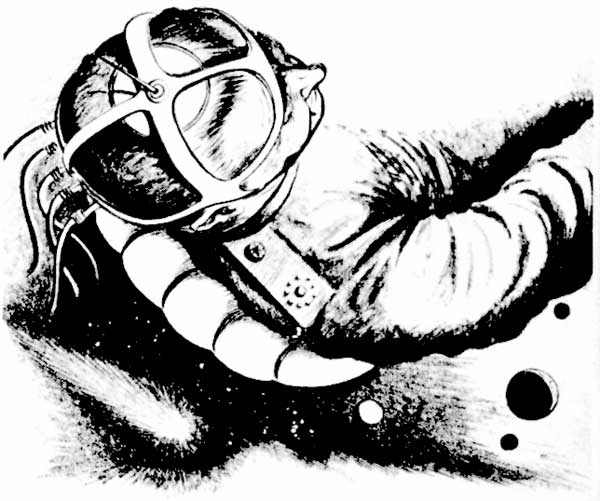
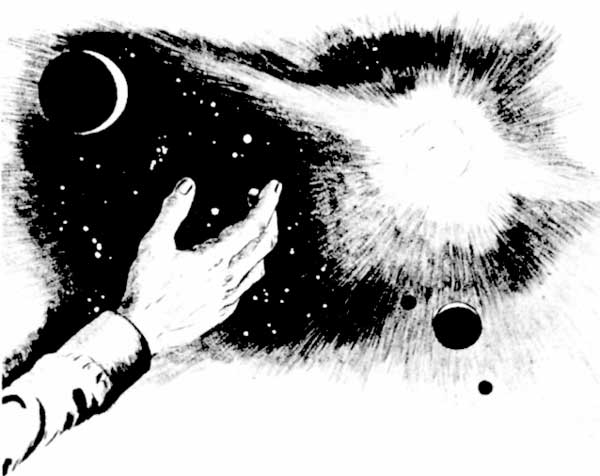
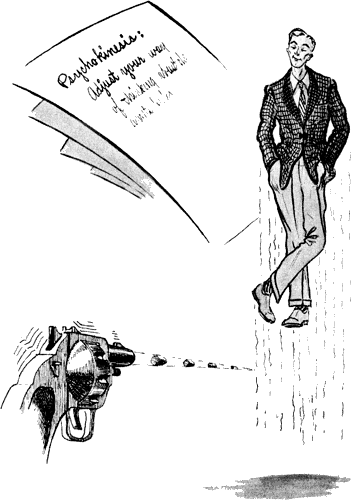
While he wrote fun stuff, his main aim, it seemed to me, evolved until his goal was to make SF realistic. How might it really happen? He liked the fun stuff, but he wanted to make SF serious (contrast this with the image above--fun, absurd, and perhaps helpful for sales off the magazine rack, but it undermined the serious intent that some wanted to invest in the field).   

He won a Hugo for his scholarly book about Isaac Asimov, Foundations. Asimov's SF, the magazine, will be publishing the last story he wrote next year. They also have an essay about religion and SF. The marvel of Jim Gunn--one of the reasons many called him a gentleman--was that everything was up for discussion, in person, in stories. You could disagree with him, and it did not affect your friendship. It will be good for humanity if we could have more of his kind on the planet.

I studied under him several times both online and in person: to learn about SF and stories. When it came to SF, his advice was always wise.

I restarted his online classes, and he tasked me to round up students. To make it happen, I had to use myself twice, once as myself and once as a pseudonym. I divided my artsy self from my science-y self and wrote SF and speculative stories. I varied my critiques, likewise. My critiques for myself, which might seem to be tricky, weren't too hard as they described what I intended to do in the next draft. I pulled off the pseudonym so well, that when I admitted to what I'd done, he didn't believe me. I pointed out that I paid for "both" students, which I think I must have originally explained that "he" didn't have a checking account. Electric Velocipede, a fun little zine sadly no longer in print, published the story under my real name.

I reviewed a number of his works over the years and interviewed James Gunn here.

If new memories occur to me, I'll add them here, later. 

    Sunday, July 31, 2016

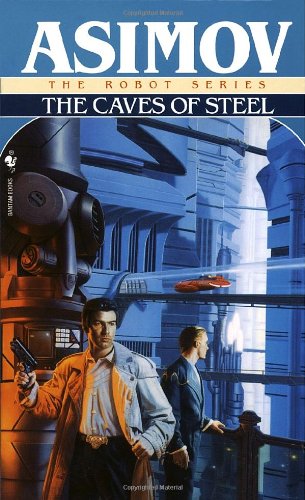
    Caves of Steel by Isaac Asimov

    Isaac Asimov dabbled in mystery and SF, occasionally combining them. Apparently, the first of these, Caves of Steel, is being written as a movie. The BBC made it into a TV movie by in 1964--of which only excerpts exist.


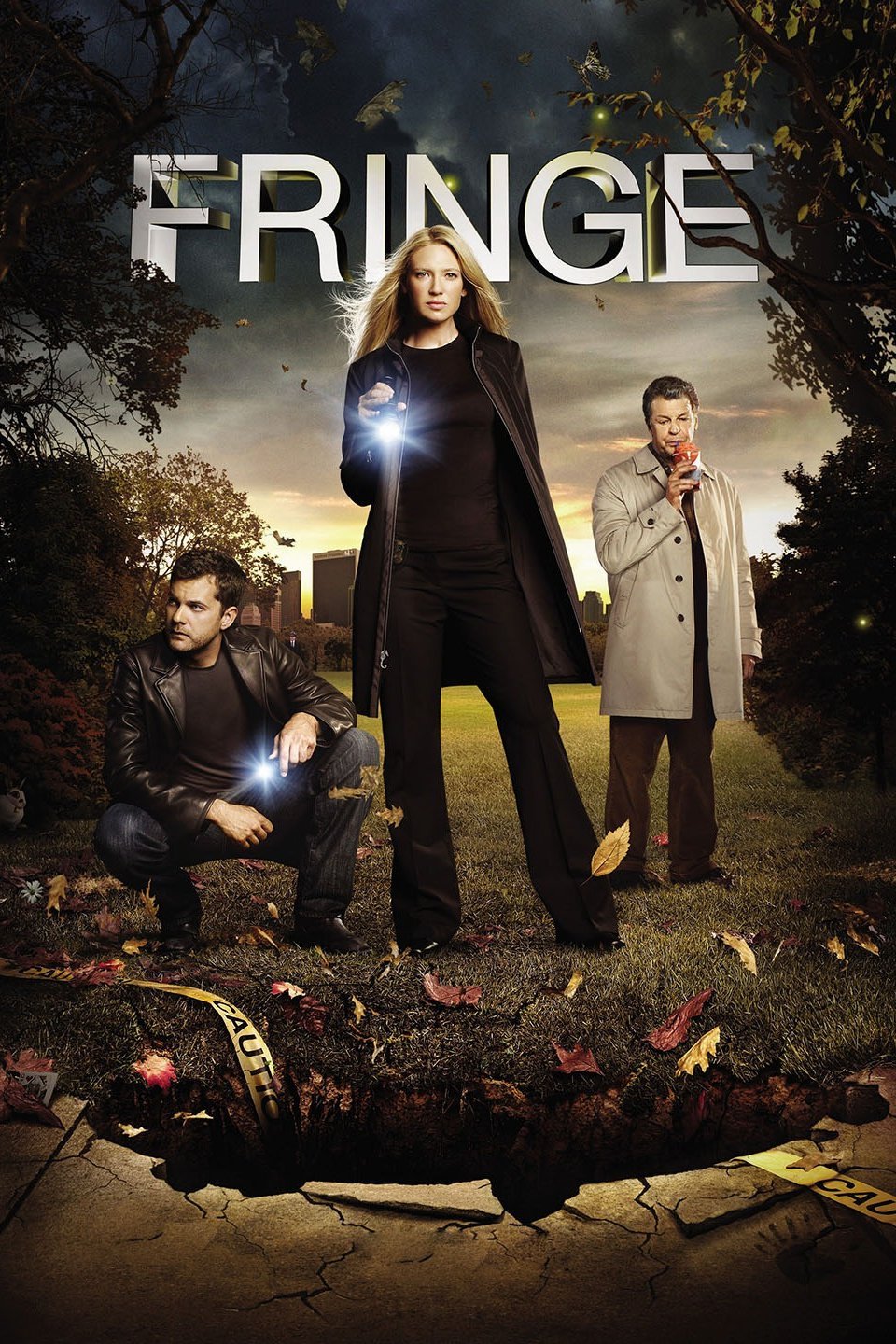
    Akiva Goldsman, Oscar winner and screenwriter of I, Robot and Fringe, is slated as the third screenwriter to give it a go for Fox. How many before Fox? It may be difficult to put on the big screen. Another attempt of turning the novel into a "movie"--or, rather, a VCR game:


    [Side note: The I-Robot credit will turn off many, but it actually does utilize a number of Asimovian plot turns and verbiage. I, Robot was also a short story, so to fashion a movie out of it is impressive. No, it isn't what Asimov would have written but it keeps and comments on Asimov's ideas--not to mention maintaining Asimov's works in the public eye.  I have only read Ellison's script opening to I, Robot and, though I enjoy the work of both writers, the opening didn't grab me. SF Encyclopedia [John Clute] writes:
    "the screenplay itself makes clear how difficult it would have been to translate Asimov's archaic concepts... onto the contemporary screen."
    I will try again, later. 
    While Goldsman's Batman films and a few others were regrettable, he did a fine job on A Beautiful Mind on other adaptations like I, Legend. Fringe was a romp. Yes, he differs from the original books, but that's okay. They weren't mockeries, but rather interesting deviations. One can always examine the original. One could complain of a Hollywood treatment, but isn't that the point? To sell movie tickets? How many more books were sold because of the movie?]

    Summary:
    Earth Detective Elijah Baley is told he must work with a humanoid robot, R. Daneel Olivaw (the "R." stands for Robot) to solve a murder of a Spacer. On Earth, by law, robots don't look like people, but Olivaw does not appear robot-like. This gives Olivaw an advantage (Olivaw threatens violence to Earth citizens) until a rumor circulates that Olivaw is a robot. Baley's own wife hears the rumor which worries her about Baley's safety.

    The Medievalists is a society of Earthlings who hearken back to a less technological day of wearing glasses or using windows. They seem benign enough: Baley's boss and his wife are members. But when they make signs to one another at a dining hall where Baley and Olivaw eat and pursue after Baley and Olivaw in a chase scene across slidewalks, they seem a lot less benign.

    Though Baley tries to prove his partner, Olivaw, is the true murderer, Baley gets no closer to finding out who did it. In fact, evidence seems to point to Baley himself. The Spacers and Olivaw get what they came for--proof that Earth would have citizens willing to go into space--so that Baley appears to be left to pay for a crime he didn't commit.

    However, Baley thinks up a loophole that gives him an hour and a half to solve the crime.

    Themes and importance:
    Asimov extrapolates a few key speculative ideas:

    1. Overpopulation leads to city overgrowth, to the extent that people fear going outside. Agoraphobia. The works well with the mystery, limiting what characters would and would not do.
    2. Technophobia on Earth leads to Earth's phobia of robots, especially robots that look like humans. 
    3. Technophiles are the few who escape Earth and building colonies. These, the Spacers, are the elite. They do not have disease and comparatively long-lived.
    4. Space colonization is so lovely that Spacers are willing to overlook murder if it can achieve a greater aim.
    5. Being long-lived leads to complacency, which ironically a spacer cannot be. Therefore, the Spacers have to recruit from Earth.

    The Caves of Steel has its admirers. James Gunn used it to teach SF--one of the major novels shaping SF. It is one of the first major SF novels to treat robots, overpopulation, and mystery in SF. The theme of the importance of space colonization was common if not ubiquitous.

    This last, for me, was the Achilles heel--not because I'm against colonization but because it was above questioning. Spacers (only here, not later) are too benevolent and wonderful. They provide an instant contrast that glorifies colonization and berates those rubes who remain on Earth.

    Asimov corrects this in The Naked Sun, creating Spacers with their own foibles, which is the better novel for this and for a mystery that plays a little more fairly. The contrast between societal flaws is fascinating. I'd love this one to become a movie, but it does hinge somewhat The Caves of Steel. So maybe it has to be written first.

    Thursday, May 8, 2014

    On Reading part 2: Reading Protocols, or I can't believe you don't read / think / see the world like I do

    Will Self's interest in the serious novel and Chuck Windig's retort also sparked this half of the essay--from a different slant of light.

    Upon request, I collected links to my online writings, often experimental back then (some good, some so-so), and bumped into old reviews of earlier stories.  I found one review angrily (why angry?) slammed me regarding a story whose style/structure I borrowed from Paul Auster and Charles Dickens.  Mostly the insinuated complaint was that I made them think in ways they weren't accustomed to.  I've since realized SF isn't a genre for difficult stories and books.  Look at Philip K. Dick's and Harlan Ellison's reaction to Samuel Delany's Dhalgren (Wikipedia):
    "By contrast, fellow writers such as Philip K. Dick and Harlan Ellison hated the novel. When the book appeared, Ellison in the L. A. Times (Sunday, February 23, 1975, p. 64) wrote: 'I must be honest. I gave up after 361 pages. I could not permit myself to be gulled or bored any further.' In an interview 27 years later, he said: 'When Dhalgren came out, I thought it was awful, still do ... I ... threw it against a wall.' Dick called Dhalgren 'a terrible book' that 'should have been marketed as trash. ... I just started reading it and said this is the worst trash I've ever read. And I threw it away.' "
    Why did they react angrily?  It wasn't a game they wanted to play.  Unfortunately, that's what people do.  They trash things they don't like reading.  Some people dislike SF.  I quit dating someone who said, "So you like reading SF?" and laughed (not that that was the only reason, but a constellation of similar symptoms*).

    Each book, each genre plays its own games.  You have to be versed in the game, familiarize yourself to the rules.  Delany speaks of SF reading protocols [summarized here--Heloise Merlin, very sharp gal whoever she is].  So, too, do James Gunn and Jo Walton.

    But it confuses people as well.   H. P. Lovecraft's 1927 essay “Supernatural Horror in Literature” trashes Henry James because he doesn't focus on what Lovecraft does--the singular lens of fear.  I find James a more rewarding experience in terms of style, character, and thought, but your mileage may be different.  Maybe fear is your only criterion for evaluating literature.

    Here's the Scratch Interview with Jonathan Franzen by Manjula Martin [registration required].  Not a Franzen hater myself (I don't know why people hate him and don't care), I found this curious:
    "MM: Define 'serious novel.' 
    "JF: Read the first five pages. Count clichés. If you find one, the buzzer goes off: it’s not a serious novel. A serious novelist notices clichés and eliminates them. The serious novelist doesn’t write 'quiet as a mouse' or paint the world in clichéd moral terms. You could almost just substitute the adjective 'cliché-free' for 'serious.' "
    So Franzen's singular lens is the cliché.  Clichés are not admirable, of course, but literary artists have used them, sometimes purposefully.**  Here's Aaron Sorkin, Academy and Emmy-award winning American screenwriter, producer, and playwright who reused a few lines.  (Even better is this Slate parody with Josh Charles and Amy Schumer .)

    Here's Junot Diaz's complaint of his MFA experience and Karin Gillespie, a self-professed Chick-Lit writer, on hers.  Again they both seek people who write what they're interested in.  No shame in that.  But neither should what they do be the only reading/writing protocol that exists.  It surprises me why more readers and writers haven't glommed on to this.  Anyway, I am glad Diaz has created an MFA program for what he sees as the proper lens for literature.  The more lenses, the merrier.  Find what fits for you, but do try on different lenses.  See what it looks like inside someone else's spectacles.

    Side notes on the cliché:

    * a cliché from medicine applied to different circumstances.

    **Like word choice, clichés can lend a character a certain voice, depending on the type deployed.  No character or person is cliché-free unless you were able to write and revise everything you said before you said it.  Not that a cliché  should be any writer's first choice, but that there may be legitimate reason to use one, sparingly.  However, I can imagine some writers/readers where this is the only point of writing--being cliché-free.  Someday, technology will uncover just how many phrases writers have borrowed from other writers.  It may be higher than we suppose.  Maybe we'll be able to quantify the tolerable number of cliches--or the uses of a phrase which makes it a cliché, or how those clichés are deployed.***

    *** I'll give examples of how clichés used well in the article, " 'A Dozen of Everything' by Marion Zimmer Bradley (or cliches can characterize)" clichés also used by Penelope Fitzgerald, Booker Prize winner, and Garry Wills, Pulitzer and National Book Critics Circle winner, who probably consider themselves serious).

    Thursday, September 26, 2013

    Tuesday, August 27, 2013

    Preview of James Gunn's Transcendental

    Grandmaster James Gunn's Transcendental has just been released. Fantasy Hotlist has an excerpt.

    A taste of the novel (one of the more mysterious aliens on this Canterberian-Tales journey:

    "A tank with treads, like a motorized coffin, stood in front of the window—a poor location for a creature whose fragile life-support system needed this kind of protection. The tank was decorated with engraved designs that Riley would have liked to examine more closely, but alien sensitivities were unpredictable. He had no desire to cause interspecies conflict, but the tank, for that’s what it most closely resembled, piqued his curiosity, if for no reason other than its unusual exterior. The tank had no windows, no obvious means of observing the outside world, as if the outside world was irrelevant or the occupant, if there was an occupant at all. It was impossible to discern anything at all about the interior of the tank. For all he knew, the tank itself might itself be the alien creature; or, if there was an alien within, it might already be dead or near-dead and being sustained by some high medical art."

    Tuesday, August 20, 2013

    Career Moves (teaching, writing and otherwise)

    Teaching
    "Said No Teacher Ever"  -- humorous video although I actually have said one or two of these.

    20 tips on 10-min improvements on the classroom

    Classic science demo--gravity with  parallel to siphoning--explained with video

    A teacher opines on what makes a good teacher

    The collapse of teachers preparing students for college (one teacher's lament of testing procedures)

    Writing
    How to be happy as a writer

    Sci-Fi author gets date... in alternate universe (joke post)

    James Van Pelt on David Jauss on Charles Baxter's ideas on the epiphany

    Gareth Powell interview

    James Gunn interview

    Stuck?  David Farland offers suggestions
    He also describes how to get an agent and how to brainstorm ideas.
    7 elements of military SF

    Aimee Bender on the habit of writing (writer's contract)

    Michael Blumlein's limited edition of collected short fiction

    Infinity Plus gets a face lift.

    Extending your career through ghost writers

    Writing and Otherwise
    Tony Tost on transitioning from poetry to television scripts

    Cross-fertilization of being a scientist and a writer (J.M. Sidorova)

    Photos of the "invisible world" as art

    Joss Whedon on being prolific:

    1. REWARD YOURSELF EARLY AND OFTEN (reward yourself for everything you accomplish)
    2. FILL THE TANKS (read widely for inspiration)
    3. ENLIST YOUR FRIENDS (mix social and work)
    4. TOUGH LOVE (no excuses--go do it)

    Monday, July 8, 2013

    The Idea of Ideas and IO9's interest in Avatar

    From the article titles alone, IO9 appears to like Avatar with a desire to have it shell out money to certain parties.


    The authors seem semi-unbiased--Charlie Jane Anders appeared to place little stock in the claims in the comment section: "you could easily do a list like this for Star Wars. It's just funny how eager people have been to point out what sources Avatar 'ripped off.' "  But the titles as a group do accidentally lead us to the subtext that Cameron is guilty.

    This brings up a slew of questions:  Where's the demarcation?  What is plagiarism?  What's coincidence?  What's homage?  What's wrestling with other people's ideas?  The waters get murky because if you've studied genre history and/or studied with James Gunn, you learn authors actually responded to one another's ideas.  For example, Tom Godwin's "The Cold Equations" still has writers arguing with him.  As does Robert Heinlein's Starship Troopers, which has some of the biggest names in the business respond:   Joe Haldeman, Orson Scott Card, and John Scalzi.

    With Robert Sheckley, I discussed the similarities between Stephen King's Running Man and Sheckley's "The Prize of Peril".  Sheckley said he had called up King and asked about that.  King admitted he'd read the story and admired it, but it had been awhile.  Essentially, grist for the mill.  Sheckley accepted the answer.  What a generous heart that man had.

    Most likely the articles are intended to provoke thought and discussion although I can't help but feel some sympathy for the artist and wonder what's next for art, especially as copyrights keep getting extended indefinitely.

    Friday, June 14, 2013

    "The Game of Rat and Dragon" by Cordwainer Smith

    Bibliography: First appeared in H. L. Gold's Galaxy.  Available online.  Also part of Dozois' ebook, Magicats, and in a number of major anthologies:  Dikty's Best SF; Robert Silverberg's The Mirror of Infinity: A Critics' Anthology of Science Fiction; Patricia Warrick, Martin Harry Greenberg, Joseph Olander's  Science Fiction: Contemporary Mythology, James Gunn's The Road to Science Fiction #3: From Heinlein to Here; Kingsley Amis' The Golden Age of Science Fiction; Isaac Asimov and Martin H. Greenberg's Great SF Stories: #17 (1955); Robert Silverberg's Century of Science Fiction 1950-1959; Wesleyan Anthology of Science Fiction; Pat Cadigan's The Ultimate Cyberpunk; David G. Hartwell and Kathryn Cramer's The Space Opera Renaissance.


    The above list ranks this as a major story in the field.  Interestingly, not only is this important, but Cadigan lists it as a forefather to cyberpunk and Hartwell/Cramer to space opera.  It is due in large part to its inventiveness--inventive with amazing if dizzying economy:

    "Pinlighting is a hell of a way to earn a living."
    What kind of occupation is Pinlighting?


    "As he waited for the pin-set to warm up, he remembered the girl in the outer corridor. She had looked at it, then looked at him scornfully.
    " 'Meow.' That was all she had said. Yet it had cut him like a knife."
    Girl = cat?

    "As he relaxed, the comforting solidity of the Sun, the clock-work of the familiar planets and the Moon rang in on him."

    Comforting solidity of the Sun?  This is the strangeness that pushes away some readers, but pulls in the true-blue, the die-hards.

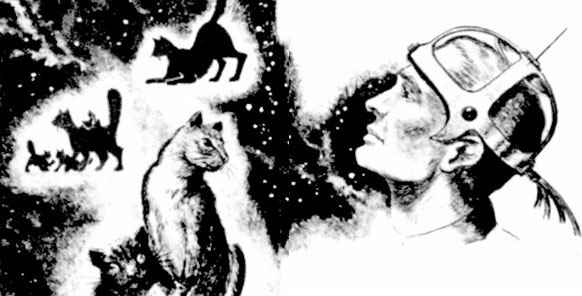
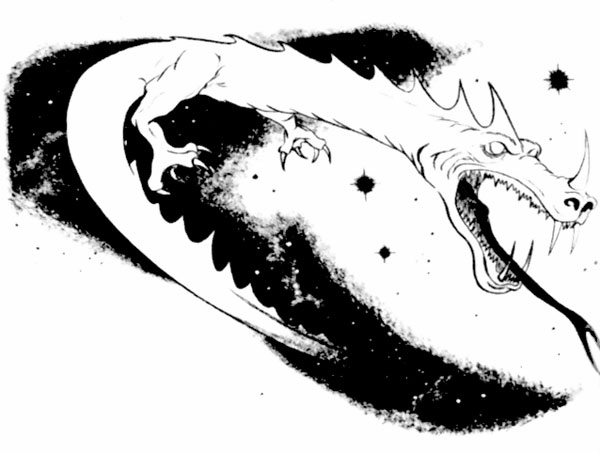
    Underhill pinlights with his cat, where they mind-meld and hunt creatures they call dragons in space.  Only cats are fast enough to kill the dragons.  They kill off dragons.

    Curiously, like Fredric Brown's "Mouse", the cat measures favorably against women (hinted at in the above, early quote.


    Tobias Buckell recently did a semi-controversial homage to Smith at Lightspeed:  "A Game of Rats and Dragon".


    Commentary:


    Saturday, October 20, 2012

    The Mystery of UFOs

    Having recently rewatched the 1977 Close Encounters of the Third Kind, I wondered what made this such a phenomenon.  The aliens are totally cloaked in incomprehensibility.  Later, Spielberg would make the alien human in E.T., which makes the popularity understandable, but the complete mystery of Close Encounters must have tapped into a 70s zeitgeist.  Perhaps piggybacking on Close Encounters, Omni Magazine, 1978, survived the era's surfeit of science magazines by including paranormal phenomena and treating them as seriously as science.  But that era's acceptance of mystery had to have precedent.

    In discussing aliens, Wikipedia notes the background events of Orson Wells' 1938 radioed Martian hoax on the public, 1947 Roswell, and subsequent proliferation of UFO religions.  Literary precedents include H. P. Lovecraft's (~1920-1930s) inexplicable horrors and James Gunn's 1972 The Listeners, which is said to have inspired a number SETI scientists.

    Lovecraft's focus, however, is the evocation of horror and Gunn's is the scientific progress needed to uncover communication with aliens.  Close Encounters, meanwhile, touches on all of the above:  government cover-up, horror, hoax, science, and perhaps most significantly an almost spiritual encounter with the other.  Spielberg plays up the mystery of light, simple music, and visions of mountains reconstructed in mud, clay, charcoal, and most famously mashed potatoes.  Not just the aliens behave inexplicably but those visited by aliens.  Roy tears up his and his neighbor's yard to the spectacle of the neighborhood.  Every time Roy tries to patch up things with his wife, his obsession with aliens intervenes.  He asks, "What is it?" and "What's going on?" but there are no answers except MacGuffins like the mountains and light and sound.

    Music of the film, the soundtrack of which went gold, plays a more integral part of the storytelling as the UFO's theme is revisited.  Wikipedia states, "In 1998, Spielberg recut Close Encounters again for what would become the 'Collector's Edition' .... but omits the mothership interior scenes which Spielberg felt should have remained a mystery."  And Roy volunteers to be taken away from his family into the bright unknown.

    What a curious film, and how curious that it captured the imagination of so many, relying as it does on the impact of mystery.

    Thursday, January 27, 2011

    James Gunn on Isaac Asimov

    West Virginia University hosts James Gunn's speech on Asimov at their October '10, Festival of Ideas. KU's Center for Science Fiction has the video from that event.