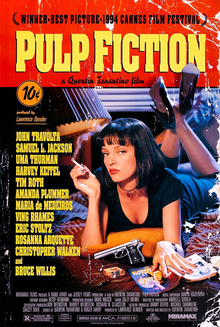
Pulp Fiction [PF] came out almost 30 years ago. If the audience or critics ranked their favorites of the 90s, I bet it would come out on top. It's hard to argue with Titanic or Silence of the Lambs--popular films in their time that people continue to talk about--but PF should still rank the highest.
This might surprise some, for reasons I'll discuss below, but I still think it'd be at or near #1. My favorites of the 90s weren't nearly as big. Time Out and Rotten Tomatoes rank it #1. Probably others. (A bunch of other movies I should rewatch.)
I don't recall my first viewing or if there were multiple viewings, but my latest viewing differed from the first. My first viewing loved everything. There was a coolness about it. The title, the characters and their blithe approach to murder, the way the film repurposed old things and made them feel new and refreshing, the memorable dialogue, the funky plot. Memory told me this was one of the greats.
I rewatched it to see what made it tick, and was surprised. The plot, while beautifully intricate, is rather thin. It's almost like the movie was composed of Tarantino's favorite outtakes (i.e. "Kill your darlings") from every script he'd ever written. Memorable lines, albeit asides. They don't actually advance a plot. Rather, these are show pieces. Dialogue that actors would love to speak. If I suggest Tarrantino is show-boating, this isn't bad-mouthing. It works.
Crazier still is how he brings in five decades of film and music together in one work. I suspect this aspect would be lost on younger generations. They'd probably only see the plot unless they did some deep-diving into movie and music history.
The cussing, when I'd first watched it, felt normal after I'd worked on a ship that had deployed a similar barrage. Since PF, everybody and their dog has drowned the media in cussing so that it's lost its original power. Some find a barrage hilarious, but to me, it's like saying, "Nissan that Nissan guy!" Okay, so what? But Tarrantino makes the swear words hilarious, spins straw into gold-plated art.
The title, while cool, detracts. Crime Stories might be more accurate but less compelling. Only Bruce Willis's story feels pulpy.
One description called it a gang story. Follow the characters. This isn't a gang story--even if it's a pervasive element--at least it's a far cry from being a typical gang story.
The movie uses these definitions, for pulp/fiction:
1. soft, moist, shapeless mass or matter.
2. A magazine or book containing lurid subject matter and being characteristically printed on rough, unfinished paper.
Is this a self-critique? Or maybe a modus operandi? "rough, unfinished" and "lurid" and "shapeless"? Apart from "lurid," which is accurate, only in a nonliteral sense does the title sort of work. Shapeless, sort of--you could ask a number of scenes why they were included--but some of it is beautifully sculpted, and it has finish (some of it, pyrotechnically so) if a little rough in places. Certainly it is not your usual blockbuster. Maybe this is what they had to do to justify the film to the producers (or critics) who might have complained.
Off topic: the movie made 25 times its original investment, the low operating cost is somewhat surprising considering the names that worked on the film.
Minor spoilers:
I misremembered the plot. I thought it was more of a Shakespearean tragedy where nearly everyone died in the end. Instead it ends with the character who has the most compelling story: Samuel L. Jackson's. The narrative switches around and really, few of them land. Just Jackson followed by Willis but his story, while it takes us on some wild loops, isn't as surprising. Jackson's transformation is wildly surprising and feels so authentic. He reframes his whole existence in a line (rewritten from the original, btw)--plus, his newfound change is immediately put to the test. Frankly, I don't recall that at all. Travolta's character story only works in light of Jackson's as a sort of foil.
I misremembered the plot. I thought it was more of a Shakespearean tragedy where nearly everyone died in the end. Instead it ends with the character who has the most compelling story: Samuel L. Jackson's. The narrative switches around and really, few of them land. Just Jackson followed by Willis but his story, while it takes us on some wild loops, isn't as surprising. Jackson's transformation is wildly surprising and feels so authentic. He reframes his whole existence in a line (rewritten from the original, btw)--plus, his newfound change is immediately put to the test. Frankly, I don't recall that at all. Travolta's character story only works in light of Jackson's as a sort of foil.
Could a writer replicate this work as a novel? I don't think so although, no doubt, many have tried.