Search This Blog

Showing posts with label psychology. Show all posts

Tuesday, April 2, 2024

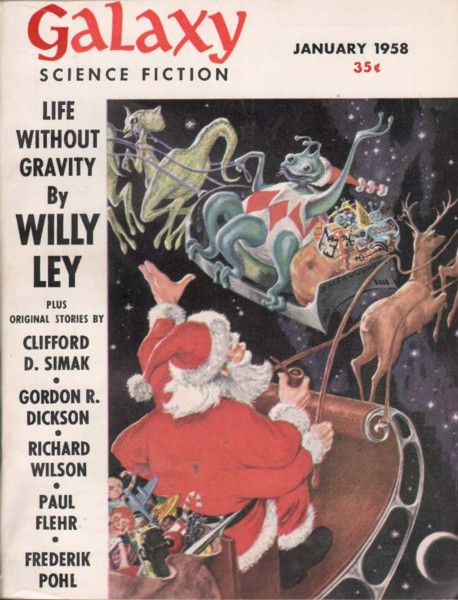
"The Hated" by Frederik Pohl

https://www.isfdb.org/wiki/images/0/02/MLO4445.jpg

Originally appeared in H. L. Gold's Galaxy. Reprinted by H. L. Gold in a magazine retrospective and by Robert Hoskins. Read online here.


Summary:

What happens to a crew bound for Mars, after years of living together?


Discussion (Spoilers):

This is a masterwork of voice and psychology. Pohl speculates that long-term, cramped living conditions might lead to hatred toward the people you live with--from a sneeze to a cough--leading to murderous intent. Psychologists think they've accomplished some greater good, but they very well may not have.


Saturday, May 9, 2020

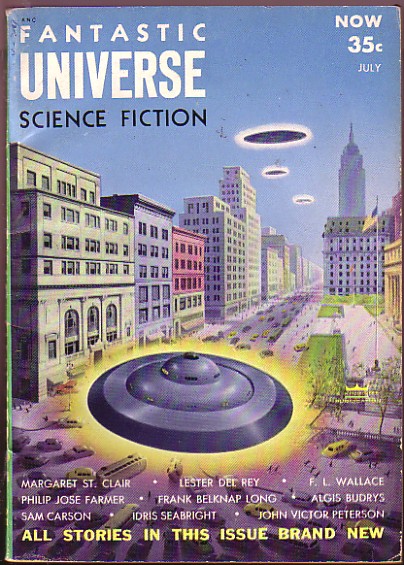
“Short in the Chest” by Margaret St. Clair


Written under the pen name of Idris Seabright, it first appeared in Leo Margulies's  Fantastic Universe, reprinted in two retrospectives by Martin H. Greenberg, Joseph D. Olander, Pamela Sargent.

Summary:

A female marine undergoes psychotherapy with a huxley, a robot psychologist concerning her lack of interest in her sexual partners from the other military services (Air and Infantry). We gradually learn that the services occupy the solar system and are at odds with one another; hence, the liaisons with members from different military services, and it seems everyone is military.

Commentary with Spoilers:

The huxley eventually points out (though it seems taboo) that she would be interested in a Marine, were it allowed, hypothetically. It talks her into killing her next would-be partner. The huxley has been recommending this course of action with all of its clients.

It isn’t clear what the huxley stands to gain from this scenario. It seems to want to spark a war between the services. Perhaps we are to assume that the huxleys want to take over, for some reason, yet unestablished. The title suggests a contrast. The literal electrical short suggests something is wrong with the huxley’s chest, where we would house our heart. The metaphorical aspect might be that a female would be “tall” in the chest, both physically and emotionally [heart], yet it is those things that the huxley and this society undermines.

As for the military services, there is—and probably always has been—a rivalry between them, but not to this extreme. What the branches are up to in this society seems even less clear. After all, the client, Major Sonya Briggs, is in charge of “piggery” which is trying to maximize pork output by weening piglets too early, but the piglets are dying off. I suspect this is a metaphor for what is happening in their society as well, removing children from parents and putting them in these services, but to what end? More people? The people—at least the women—don’t seem especially interested in the venture.

What must have impressed editors who selected this tale was the high level of semantic invention, the high speculative bar about the society (uncommon in St. Clair’s work), the psychoanalysis (Frederik Pohl uses a similar scenario in his most famed novel, Gateway—was his model this precursor?), the topic of sexuality—a subject that would become a hot topic a decade later—which presumably was hidden from the usual taboo by calling it “dighting.” 

But it has St. Clair's usual problem with talking heads (which tries to avoid by having Briggs do a type of knitting, but to little narrative advantage) and not fully thought-out complexity. This seems to be more important in its influence rather than its effect although it could be argued that influence lends the tale a strong effect.

Saturday, March 9, 2019

Two videos dealing with the aftermath of WWI

This video about Anna Coleman Watts Ladd, a sculptor (wiki link includes more personal info) who made masks for facially disfigured survivors of WWI in France. Warning: Slightly grotesque, and her miracle work might make you weepy.

#

The second video, below, treats how soldiers with PTSD (or shell shock) were treated in that era by different countries.


Thursday, May 18, 2017

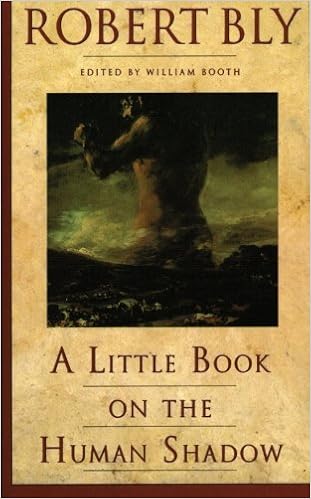
Review: A Little Book on the Human Shadow by Robert Bly

Had I known what kind of book this was, I might not have bought it. But then again, I might have. It is a strange hybrid on poetry, writing poetry, myth (fairy tales--not in the pejorative sense, but I'm sure some would like to apply that as well), self-help, and pop psychology. Clearly, Bly saw a deep connection between all of these things, and part of the appeal is how strongly integrated he views them. He takes the entire field of poetry (especially Wallace Stevens) to task for not using these ideas as he has. Most writers consider their field of study as pointless. See my review of David Orr's Beautiful & Pointless, so it is gulp of cool water in so vast a desert to come upon Bly's drinking trough.

Note: I do not tend to write glowing reviews. I try to steer away readers who would dislike such a book. Most books, like humans, are flawed and sometimes those flaws are part of the appeal. I hate to state this over and over for every review, though.

I also bought the audiobook that followed after this edition. It is always curious to read (or hear) how a writer revises his work after second and third thoughts. Bly is uncannily honest and states in the audio that his work has truth and lies, but he doesn't know which is which.

There is a great deal of useful information in here, and a little that rings less useful. The overview: Bly asks that people find balance in their writing and their lives. We have a tendency to blame our failures on others, but Bly states we should take ownership, pull out the aspects of our personality that we've hidden away, and develop our lives fully.

First, a definition, if possible: The shadow is the darker side of ourselves, which we need to embrace. The shadow is not evil, Bly said. Following Bly's definitions requires paradigm-shifting, not to mention accepting squishy definitions.

The book is divided into five sections:

  1. Problems in the Ark. This details the author's own experiences in finding his shadow and dealing with it in his poetry. Later, he points out that some of the things he hated in others (Alexander Pope, businessmen) he had in himself, and he had to accept this before he could appreciate such men. Paradoxically, he mentions politicians he also hated (or at least he suggested he did), so perhaps this is a never-ending process.
  2. The Long Bag We Drag behind Us. Society tells us to hide certain aspects of ourselves. These aspects (the feminine, the masculine, the witch, the giant, the shadow, among others) we hide in a bag and drag it around with us.
  3. Five Stages in Exiling, Hunting and Retrieving the Shadow. We start at birth and, say, hand our witch to our mothers (who expresses it for us) and later hand it to our wives. The witch is what allows us to get what we want. We need to retrieve this by asking for these missing parts back.
  4. Honoring the Shadow. This is an interview with William Booth, the editor, who gets Bly to expand on ideas he mentions only in passing earlier, such as eating one's shadow, etc.
  5. Wallace Stevens and Dr. Jekyll. Bly believes the personality is also a part of the poet and needs to be examined as part of a poet's oeuvre. Stevens, Bly says, brought out the shadow in his poetry, but never lived it out in his own life, so the gifts of the shadow were wasted on Stevens and this shows up in Stevens' late poems.
The positives of the book outweigh the negatives. The main positive is asking people to face themselves, instead of shifting responsibility on others. This could also be a negative since people often create or contribute to a problem, but at some point, we must realize the person who may have done damage doesn't care, and we must work through issues for ourselves. One can read an abundance of poetry where that is its primary failing. It keeps stumbling over the flaws of others as if that were one's only failing in life: other people.

This is where Bly's methodology steps in and tells you to ask for your missing parts, the aspects of yourself you gave away. I keep imagining how this might play out in real life: the puzzlement on the other person's face. 
"Hey, give me my witch back." 
"You want your what? 
"My witch!"
"Oh. Okay. If you lost your witch doll, I'm sorry, but I don't have it."
Still, it is a physical statement, a stance that makes the metaphor real, which is both good and bad. The good is that you are telling yourself that you are changing. The bad is that it is a metaphor:
"Projection without personal contact is dangerous. Thousands, even millions of American men projected their internal feminine onto Marilyn Monroe. If a million men do that, and leave it there, it's likely she will die. She died."
It may be within the realm of possibility that that is why she died, but it seems doubtful. Unless she were part of a hive mind, she probably had her own issues. One of the measures that some poetry readers use to decide the quality of a poet is their personal mythology. It seems likely that Bly's is unique, so maybe he'll remain within the canon for centuries to come.

Unfortunately, Bly does judge Stevens by a measure that maybe Stevens had not considered or might have rejected as part of his poetics. All humans are problematic, so to judge one because he does not follow your aesthetic is dubious at best. If we had a time-traveling recorder to mark our every misstatement, we would all be exposed as cruel. This is where David Orr's "pointless" perspective on poetry gains legitimacy.

No matter. A Little Book on the Human Shadow has plenty to recommend it. The audiobook is similar, covering overlapping territories, but it goes a little further into fairy tales and skips much of the later discussion found in sections four and five of the book. I do recommend both but with caveats, We should be examining our various aspects of personality we may be leaving out.

What book doesn't require caveats? Maybe that is the  measure of a book that takes risks. Flaws are, after all, where the personality shines through.

Tuesday, January 6, 2015

The Search for Self & Others

Self
Missing woman unwittingly joins search party looking for herself

Search For Self Called Off After 38 Years (The Onion) *

CCTV police officer 'chased himself' after being mistaken for burglar. 
"An undercover police officer 'chased himself round the streets' for 20 minutes after a CCTV operator mistook him for suspect."
* Possibly true but intentionally humorous

Others
QUIZ: Can You Read People’s Emotions?
Assess you ability to read emotions through the eyes alone. Answers not given if incorrect. Little discussion.

How to Read People Like Sherlock Holmes: 4 Insights From Research
I'm a little dubious of some of these "insights," but interesting, nonetheless.

Wednesday, September 17, 2014

Star Trek: Season 1, Episode 9. "Dagger of the Mind"

 Summary:
The Enterprise beams down goods to Tantalus V, a planet penal colony with unorthodox methods of healing its prisoners. A prisoner escapes, threatens violence to the Enterprise crew. It turns out that the prisoner was the assistant, a former psychiatrist himself, Simon Van Gelder.
Analysis with spoilers:
Kirk goes down with Dr. Helen Noel. Kirk investigates, but Noel balks. They try out the neural neutralizer for themselves and find out Kirk can be made hungry for food and Noel. Then Dr. Adams appears and.

The attempt at romance between the attractive couple was nice as was the profound ending, but this one had problems. Of the episodes thus far, this one stretches incredulity. Really, you don't inspect goods from a penal colony? No one comes to pick it up? How did they get so far away before they realized Van Gelder had escaped?

Kirk seems to have had a Christmas fling with Dr. Helen Noel, where she wanted more than he did--an assumption from her continued interest and Kirk's reluctance to have her along. Also, from Noel's described how they danced and Kirk speaking of the stars, but she tries to invest more in the scene. This leads to the "accidental" embrace in the elevator. Yet they keep holding on to one another, which negates Kirk's earlier supposed reluctance.

Moreover, on the ship, Kirk is sold on Dr. Tristan Adams due to his renown, but as soon as he begins investigation, he's dubious and Dr. Helen Noel is the accepting one. In fact, she backs up Adams with the quote below, something I suspect would be suspect if not controversial to anyone working in a psychoanalytic capacity. Really? Deleting or changing memories is that well accepted?

How did Simon Van Gelder and Tristan Adams get in this fix, anyway? I mean the true story.

Who would use a device that made a sane man insane? Captain Kirk apparently. Hey, let's see if I go insane, too!  Why does Adams suddenly turn on Kirk instead of letting him think it's harmless?

This is minor--rather humorous actually--but Kirk cannot open a screen and needs Noel's help. Later, Noel opens a screen with ease. This brings up a question of why no one on the colony has never tried to escape through the ducts before.

Now for my favorite part: the ending. When Dr. Tristan Adams eats his just desserts, the power comes back on, and the neural neutralizer empties his mind with no one to fill it, he dies of loneliness. Therefore, emptiness = loneliness, and loneliness = death. There's an unusually long silence at the end, a silent note held for longer than normal on TV, and it's eerily effective. However, Kirk breaks it with a smile, for some reason.

The episode alludes to Tantalus, a man punished for cooking his son for the gods with eternal dissatisfaction of desires--water recedes as he bends drink, branches laden with fruit always stay just out of reach. Perhaps Dr. Tristan Adams is Tantalus for having destroyed his assistant although the metaphor doesn't fit well as their punishments are different.

Likewise, the name Tristan does not appear to allude to Tristan the lover. Finally, the title comes from MacBeth (see quote below), the titular character of which appears delusional, sees a dagger, and decides quick action is needed.

Quotes:
  • "A shifting of memory patterns is basic psychotherapy." -- Dr. Helen Noel
  • Is this a dagger which I see before me,
The handle toward my hand? Come, let me clutch thee.
I have thee not, and yet I see thee still.
Art thou not, fatal vision, sensible
To feeling as to sight? Or art thou but
A dagger of the mind, a false creation,
Proceeding from the heat-oppressèd brain?
I see thee yet, in form as palpable
As this which now I draw.
Thou marshall’st me the way that I was going,
And such an instrument I was to use.
Mine eyes are made the fools o' th' other senses,
Or else worth all the rest. I see thee still,
And on thy blade and dudgeon gouts of blood,
Which was not so before. There’s no such thing.
It is the bloody business which informs
Thus to mine eyes. Now o'er the one half-world
Nature seems dead, and wicked dreams abuse
The curtained sleep. Witchcraft celebrates
Pale Hecate’s offerings, and withered murder,
Alarumed by his sentinel, the wolf,
Whose howl’s his watch, thus with his stealthy pace,
With Tarquin’s ravishing strides, towards his design
Moves like a ghost. Thou sure and firm-set earth,
Hear not my steps, which way they walk, for fear
Thy very stones prate of my whereabout,
And take the present horror from the time,
Which now suits with it. Whiles I threat, he lives.
Words to the heat of deeds too cold breath gives.
--MacBeth Act 2 scene 1, Shakespeare
                                                        Author
                                                        S. Bar-David or Shimon Wincelberg.
                                                        *Notes:
                                                        1. First use of Vulcan mind-meld psychotherapy 
                                                        2. You cannot use communicators or beam anything while shields are raised.

                                                        Thursday, September 4, 2014

                                                        Politics makes us dumber

                                                        “Divergent” and “Hunger Games” as capitalist agitprop: 
                                                        "We're all told we're "Divergent," all the time -- behind the bogus dystopia lies a panegyric to consumer society."
                                                        The horror!

                                                        YA dystopias teach children to submit to the free market, not fight authority 
                                                        "The Hunger Games, The Giver and Divergent all depict rebellions against the state, and promote a tacit right-wing libertarianism."
                                                        And I take it that this is evil as it goes against everything the article writers believe in. I agree. In fact, I've got an idea. Let's only write a certain kind of story! One kind only! With one theme. One theme only! It will never get old. Nor will the exclamation marks!

                                                        We'll check with the proper authorities to make sure it has the proper theme. I can't wait to dive into this dystopian future we're creating. I will chair the committee. All stories must be pre-approved by me or it cannot be published.  We will only publish stories that slant toward a certain political party. All unapproved published works will be burned (and their authors).*

                                                        Related, but less shocking:

                                                        Project Hieroglyph: Fighting society's dystopian future

                                                        Thought Experiments:Tomorrow Through the Past by Allen M. Steele

                                                        Here, the authors advocate positive futures.  That's great.  In fact, I'd like to get the anthology when the price goes down. Advocate whatever you want, so long as you don't say what writers can and can't write about.

                                                        Let's allow people to tell whatever story they want. If you disagree with the theme, say so. As a reviewer, I used to post the author's comments if I disagreed. Why? To give authors a voice, not to bash them. I could be wrong. I was not out to silence anyone.

                                                        Let's not create some moral imperative that any theme can or cannot be read. Open your mind. Look at negative possibilities, look at the positive. Allow yourself to read things you don't agree with. Avoid telling people not to read things.

                                                        Some scientific evidence to back this up:

                                                        David Brin discusses how self-righteous indignation gives you a high.  Self-righteous indignation is a major component of politics. (Perhaps, as self-righteous indignation gives political addicts a high, the FDA should regulate its use.)

                                                        Science confirms: Politics wrecks your ability to do math.  That's right.  Both parties got dumber. (A left-wing article reported only the right-wing problems.)

                                                        Political Diversity Will Improve Social Psychological Science: Bias can skew data.

                                                        If you want to get smarter, you have to challenge yourself. Read something you don't agree with. Excluding what can and can't be read and discussed makes you and the people you encouraged to become dumber. No, you don't have to read everything, but don't tell people not to.

                                                        You might ask, "Weren't you part of the Mundane SF lot?" Yep. Not because I was against any type of SF, but that it represented a type of SF not being voiced.

                                                        * By the way, this is satire.

                                                        Wednesday, December 25, 2013

                                                        "Becalmed in Hell" by Larry Niven

                                                        First published in Fantasy and Science Fiction. Nominated for a Nebula award and reprinted by Donald A. Wollheim, Terry Carr, Damon Knight, Edward L. Ferman, Robert P. Mills, and Gardner Dozois.  This forms a part of Larry Niven's future history series, Known Space.  Caveat:  I will "ruin" some of these Larry Niven stories as it is impossible to discuss the science without revealing the key plot points.

                                                        On Venus, human/ship Eric (character from "The Coldest Place") cannot feel his wings.  When the narrator cannot find damage inside or out, there's a friendly stalemate.  Is one or the other character mentally unstable?  Is Eric being psychosomatic?  Is the narrator stalling, not wanting to do his job?  Or is there a third solution?  When objects heat, usually they expand.  In this case, Eric was losing contact.  Good science mystery with a healthy dose of psychology thrown in.  Worth seeking out.

                                                        Tuesday, April 9, 2013

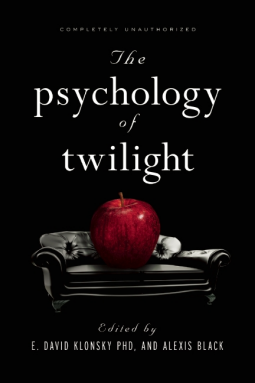
                                                        Review: The Psychology of Twilight


                                                        The Psychology of Twilight Edited by E. David Klonsky, PhD, and Alexis Black 
                                                        BenBella Books, Inc.
                                                         I love pop science books.  I snap up BenBella and other publishers' books, whether they examine the science, philosophy or psychology--even if I've never watched the show.  Sometimes I read the books, which intrigues me to watch the show.  This happened when I read Caitlin Flanagan's article in Atlantic Monthly.  Plus, my curiosity piqued when students wrote "I [heart] Jacob" or "I [heart] Edward" on their notebooks.

                                                        Anti-Twilight sentiment is prevalent due to anti-girliness (usually among adolescent boys) or to anti-anti-feminists who see the series as setting back the clocks.  Ashley Fetters smartly addresses the scenario (again in Atlantic Monthly):  different strokes for different folks."

                                                        The Psychology of Twilight also addresses these criticisms, and because they possess doctoral degrees in psychology, they do so, backing up their ideas with evidence, which is more interesting than popular reductionist theories which do not fully account for a book series.  The only way to critique the books is from the inside:  understanding them, then addressing shortcomings.  Antagonists tend to oversimplify.

                                                        On the other hand, that The Psychology of Twilight exists, may give the opposite false impression:  that Meyers wrote these books to present a treatise on adolescent psychology, but the authors almost never treat the book in this manner (occasionally, they take the series a little too seriously, but I suspect it's tongue-in-cheek or fan-girl geekiness shining through:  "Team Edward!" "Team Jacob!").

                                                        Here are the topics discussed:

                                                        1. "Bella and the Psychobiology of Love and Attraction" by David A. Frederick, et al. discusses the evolutionary causes of Bella's behavior and attraction to 
                                                        2. "Team Jacob" by Erica Berg discusses what advantages Jacob has a love candidate.
                                                        3. In "The Case for Edward Cullen" Susan Carnell tackles what Edward's psychological draw is.
                                                        4. "Prejudice" by Melissa Burkley examines human tendency to pre-judge and Twilight sometimes falls prey yet other times plays off our prejudice and others thwarts such expectations.
                                                        5. Similarly, Amanda M. Vicary and Jennifer L Rosner take the prejudice and show us different groups can get along in "Vampires and Werewolves Aren't So Different After All."
                                                        6. Mikhail Lyubansky discusses the shades of gray of Twilight in "The Gestalt of Twilight."  The unified whole cannot be understood by examining the parts.  Lyubansky says that Meyers understands that we create false dichotomies instead addressing full complexities.  Two sides may be equally correct.
                                                        7. Robin S. Rosenberg maps the vampiric urge to eat human blood on to our urge to eat unhealthily and suggests better methods in "Vegetarian Vamps."
                                                        8. Jeremy Clyman argues in "Self-Regulation: The Secret to Success in Twilight" that Edward Cullen is most attractive value is his ability to self-regulate, to withhold himself when he most wants to love or to kill. 
                                                        9. "Motorcycle, and Strangers, and Cliff Diving! Oh, My!" by Catherine R. Glenn was one of the more surprising of the articles, wherein she argues that Bella's risk-taking may actually be saving her life.
                                                        10. "It's All in the Family" by Lisa M. Dinella and Gary W. Lewandowski Jr., another surprising article, compares Bella's and Edward's family.  Edward's family of vampires wins out.  Bella is a parentified child while Edward's is a balanced hierarchy without becoming enmeshed.  This one occasionally loses sight of its target audience.
                                                        11. Tamara McClintock Greenberg's "Transcendence and Twilight" shows why immortality may be a draw for Bella.  Despite Meyer's often mentioned Mormonism, her characters do not have religion although some long for one.
                                                        12. In "The Emotional Pleasures of Reading Twilight," Peter G. Stromberg examines what is the romantic pull of such books?  The millions of copies sold testify to how it speaks to people's dreams and hopes.  Stories create feelings inside readers, especially in terms of the conclusion where the lovers finally meet.
                                                        13. Pamela Rutledge closes with "Twilight Convergence," discussing how readers have helped grow the Twilight series into a social phenomenon through new social media.  Meyer discussed and interacted with her fans, and fans didn't have to share age or race in order to feel connections.
                                                        While all are informative, the first nine articles are especially enlightening.  I feel smarter.