Search This Blog

Showing posts with label Ursula LeGuin. Show all posts

Sunday, May 5, 2019

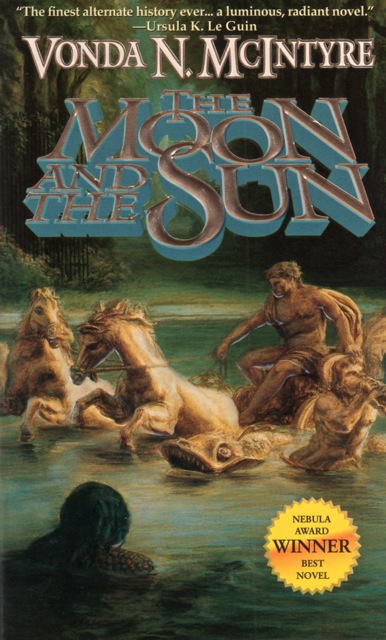
The Moon and the Sun by Vonda N. McIntyre

The Moon and the Sun won a Nebula and was up for the Tiptree and Locus awards.

Father Yves de la Croix--Jesuit priest, natural philosopher, and explorer--has returned to King Louis XIV bearing a gift of two sea monsters: one alive, one dead. Little by little, Yves does the autopsy with the assistance of his sister, Mademoiselle Marie-Josèphe de la Croix.

Marie tries to train or domesticate the sea monster as a pet, but slowly learns that there is more to the sea monster than she first supposed.

Eventually they communicate, and Marie gets a fuller understanding of this race or species. Unfortunately, the sea monster's flesh is rumored to give immortality, so they want to dine on its flesh. Marie has to come up with a way to prevent this.

Minor spoilers:

The main plot could be guessed as soon as the conflict is established. Of course, humans once again underestimate another species. The victims must be rescued. In fact, much of the basic scenario mirrors Guillermo del Toro's The Shape of Water: the capture and abuse of, and experimentation on a humanoid sea creature.

The sea "monster's" name is Sherzad--a nifty nod to 1,001 Arabian Nights. After all, Sherzad (like Scheherazade) has a story to tell to save her own life.

The first two-thirds is well written but pales in comparison to the last third except for the scene establishing communication and the autopsy which is a well-sketched painful moment. The real power comes in the last third when the court intrigue unfolds, and we learn more about this sea-person.

The speculation is rather limited, so maybe it is like LeGuin suggests above the illustration that this is an alternate history. Apparently, McIntyre did much research to capture the period, and it was convincingly captured. A historian might need to explain the departures and their ramifications.  I'm just a science dude.

When word got around Vonda N. McIntyre was ill, I decided to pull down this novel and give it a read. If I have McIntyre's ordering right, the novel began as a faux encyclopedia article, which she had to restrain from becoming a story with characters.

She took a script-writing class and wrote an earlier version of this story, which she later expanded into a novel. However, publishers move faster than the movie industry, apparently, and she published her novel well before they started shooting. The movie, starring Pierce Brosnan, has been filmed but remains unreleased pending special effects, four years later.

Maybe something went wrong elsewhere, but you'd think they'd try to recoup some financial losses by releasing it as straight-to-video, or have a limited release first. Surely, book fans would flock.

UPDATE: The movie was just released. See discussion here.

Sunday, February 5, 2017

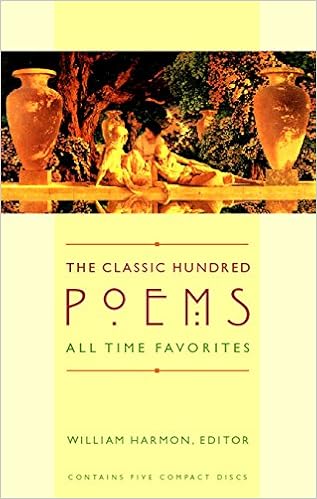
The Classic Hundred Poems: All-Time Favorites, William Harmon (Editor)

This collection is nearing two decades old. It can register to fight in wars but cannot yet drink alcohol. Legally.

It's hard to debate a clinical selection of poems. The selection is based on the tastes of other anthologists, sampling a thousand, give or take, which is a good sample size. What better introduction to the genre than the best of the best retrospective?

The title could mislead readers who associate "classic" with Greek or Roman culture when a more contemporary sense of the term is intended as applied to the English language.

The reader will find not only the best poems, but also a sense of the changes in subject and taste. One can also sense patterns. Some poets tend to build a laundry list of observations, then lay the reader out with a line that brings the observations into new clarity or context. Others seem to take one path, only to veer off into a new direction--the friction between the two making the poem of interest.

You'll see a number of famous stories that allude to these poems: Andrew Marvell's "World enough and time" (Joe Haldeman, Dan Simmons), "vegetable love" (Pat Murphy), "vaster than empires and more slow" (Ursula LeGuin); William Butler Yeats's "Things fall apart" (Chinua Achebe), "slouching towards Bethlehem" (Joan Didion). So you may as well check up on what some of your favorite authors have been up to.

Most surprising are some of the poets left out: Geoffrey Chaucer, Alexander Pope, and Walt Whitman. Chaucer could perhaps be explained as his greatest work, The Canterbury Tales, is read separately and not short enough for inclusion. Pope can be explained as using humor and satire, which some have difficulty equating with seriousness.

Whitman, though, is a curious case. One might point to homophobia, which might be the case for a few although most of the homoerotic aspects are subdued. Emily Dickinson shied away from Whitman as "scandalous" for an unnamed reason, which may be about what I discuss below. Even when you zoom out to the top 500, you see mostly topical (Abraham Lincoln, the Civil War). Only one seems to hint at Whitman's style or métier, "I Hear America Singing", but even that might be chalked up to illustrating the patriotism of his era as opposed to capturing the poet.

Another reason anthologists left him out might be his lack of meter and looser lines, which make him seem a lesser poet to some anthologists, especially considering the era he springs from. After all, he doesn't have much impact until Allen Ginsberg, so you'd have to wait to see Ginsberg's impact before assigning one to Whitman. The major reason for his exclusion may simply be the title of his magnum opus: "The Song of Myself," which is not especially humble. Readers today still find this mildly shocking, perhaps less so with the advent of Facebook and the Internet.

The primary downfall of the collection is that the notes are so far from the poems in the appendix. One might suggest that the reader doesn't wish to be encumbered by notes, but surely academics who are already familiar with Old English would already be familiar with these poems and probably not interested in such a collection.

It is a valuable collection to fill gaps in or rebuild your literary education. William Harmon also collected a Top 500 Poems--with even fewer notes. If you need notes, maybe grab a Norton anthology.

Wednesday, June 19, 2013

Close Reading of "Schrödinger's Cat" by Ursula K. Le Guin

Originally appeared in Terry Carr's Universe.  Reprinted in Dozois' Magicats, in Joyce Carol Oates' American Gothic Tales, and in  Leebron, Geyh, Levy's Postmodern American Fiction.

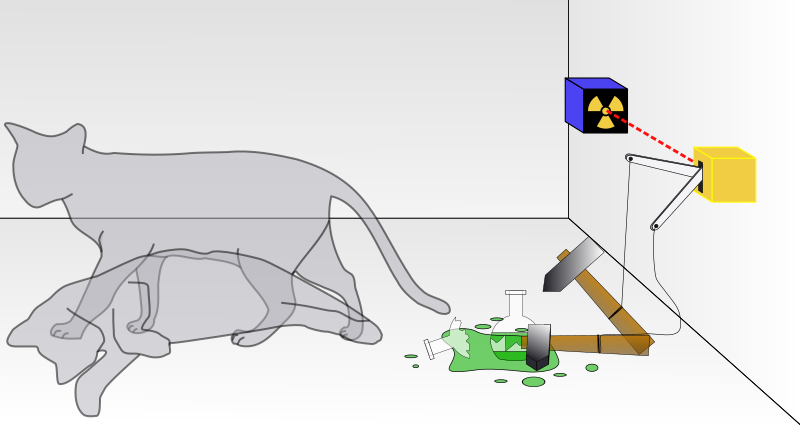
The narrator and "Rover" (if that's his name, which it is probably is not, although it is likely a part of the grander uncertainty) argue whether they should conduct Schrödinger's classic thought experiment, supposedly illustrating the absurdity of quantum theory:
If a cat is trapped in a box with (Le Guin uses a random photon release to trigger a silent gun) a radioactive substance that randomly emits radiation which may cause poison (cyanide, I'd heard) to kill a cat.  If we don't open the box determining the outcome, then cat is indeterminate both dead and alive, which is absurd--for a cat.  This, however, is now seen as the actual way we understand electron behavior.
Le Guin offers that the experiment itself is absurd, suggesting we don't know what the actual system is and who/what all is apart of it, and who are the observers impacting the outcome. A good observation about science and how, to a degree, scientists determine some of the outcome they're looking for through their observation.  More should be aware of this aspect of science.