This site passed 400,000 hits, so I did a quick scan of my favorites from the past year, plus things I read in the past year but still haven't reviewed yet.
Best novel was Theodore Dreiser's An American Tragedy, discussed here. The recollection of it still wounds. I doubt I'd read it again, but a fine, troubling novel.
"Brenda" by Margaret St. Clair (book reviewed here) -- I can't shake the imagery of this one. St. Clair was firing on all cylinders. You can find it in her collection: The Hole in the Moon. If you read nothing else by St. Clair, read this one although she has a few other well known works.
Bruce Boston’s “The Ruined Library” You can read it online here and my commentary on part of what makes it so successful here.
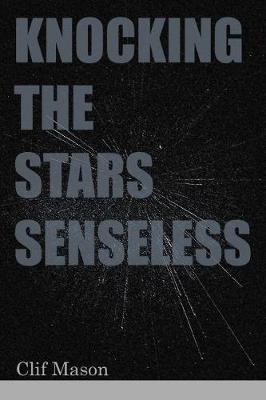
Best new poetic voice I've read in a while -- Clif Mason's Knocking the Stars Senseless (reviewed beginning here -- interview begins here)
Speaking of new voices, Daniel Braum's is one to read, reminiscent of Lucius Shepherd (short novel reviewed here, He's also published a few story collections), with future work forthcoming in Ellen Datlow's Best Horror.
Best book of poems -- Speech Minus Applause by Jim Peterson -- Catalogs the tipping of a worldview (perhaps). Some poets excel at the poem, some the book. This one does both admirably. Stunning, revelatory, haunting. I'm still writing the review--interrupted by illness and lunar lacunae. Hopefully an interview will follow.
Best series: Peter V. Brett's The Demon Cycle. It begins well with The Warded Man, but really is most stunning in The Desert Spear. Enthralling. More reviews to follow.
Two of the most thought-provoking if flawed yet highly recommended SF novels: Dark Universe by Daniel Galouye -- fascinating speculation -- is discussed here. Pierre Boulle's brilliantly designed Planet of the Apes is discussed here.
Most attention for written works: David Gerrold's novel The Man Who Folded Himself got the most hits--an eye-popping wonder--although the middle doesn't quite stack up as strongly as the beginning and end (SF readers of the old school might look into his When HARLIE Was One, a thought-provoking, speculatively high-octane work). Joe Lansdale's Cold in July, a fascinating look at the male psyche, was right up there with the hits. Jane Yolen's collection and discussion of such a literary form, How to Fracture a Fairy Tale, trailed by a nose hair.
The #1, biggest hit winner of the year by a landslide: Poet and editor, Sarah O'Brien's interview.

APB-SAL is a blog about education, science, science education, fiction, science fiction, literature, literary stories, poetry, and anything else that strikes the blogger's fancy. NOTE: This blog interrogates art. It rarely make moral proclamations. For that attend the church or politician of your choice. This blog concerns aesthetics, not propaganda. Consider this as interviews with books where the interviewer presents interviewees, so you get what you need to do your own thinking.
Showing posts with label Clif Mason. Show all posts
Showing posts with label Clif Mason. Show all posts
Tuesday, May 12, 2020

Tuesday, April 28, 2020
Interview with Poet Clif Mason, pt 4 Revision & the Future
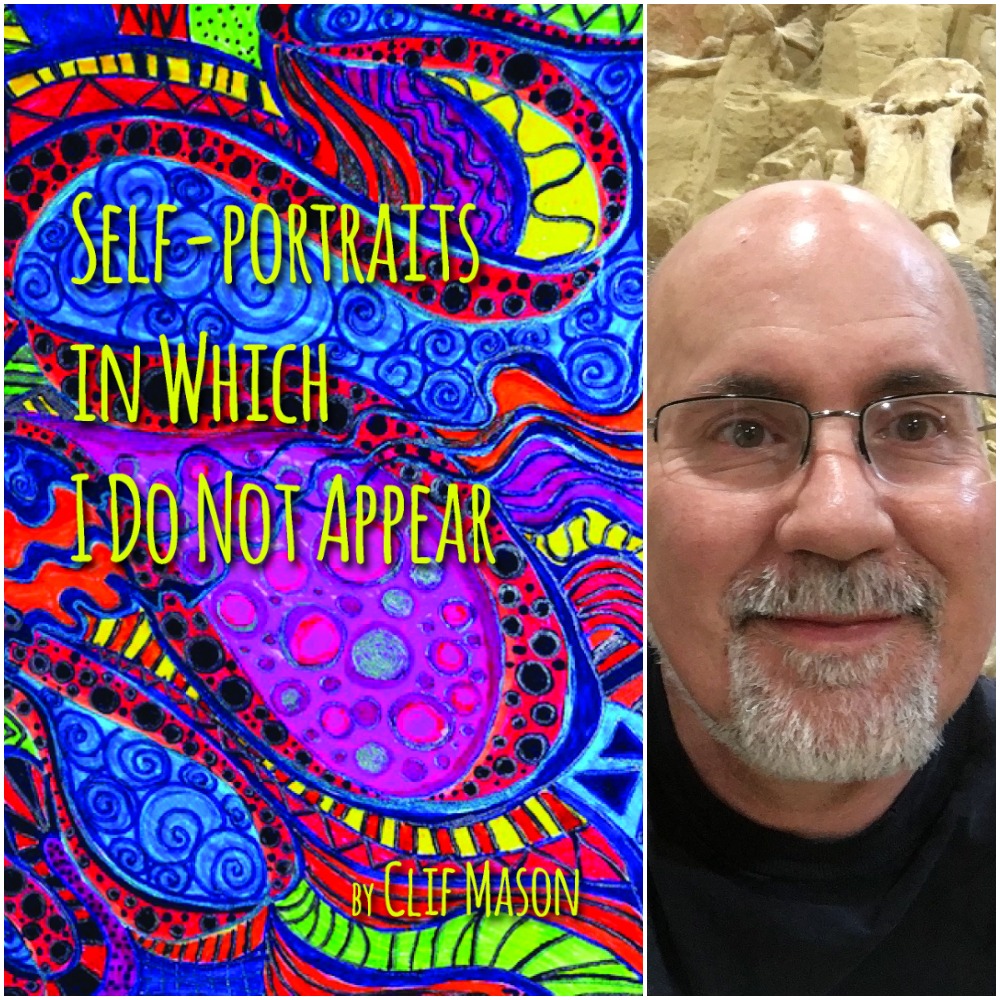
Clif Mason is an English professor and a poet with four collections published. I reviewed his remarkable debut full-length collection, Knocking the Stars Senseless, here and here (part II of the review). Since then, we've been emailing back and forth the following extensive interview on the art, craft life and development of the poet.
This interview is in four parts:
What are the critical pieces of a
good poem?
For reasons I’ve already elaborated, sound and image. To
these I would add line breaks and enjambment, which allow lines and stanzas to
gain in power and meaning through the special intentionality and emphasis they
embody. A poem comes into being when all of these elements become unified and
coherent—mutually cognizant and supporting—thereby gaining its own unique
momentum and force. That is to say, when the poem becomes a living thing, with
its own circulatory system and tissues and organs and networks of nerves.
As I pointed out in the review, you
do extensive revisions, changing not only the poems drastically, but even what
poems go in. How do you approach revision in your poems? In your three newest books?
Poems can fail in a “thousand thousand” ways, to paraphrase
Shakespeare. The desire to revise comes from an acute awareness of those
failures. For me, as for so many others, I’m sure, the ecstasy of composition
is often followed—the next day, the next month, or the next year—by dismay,
disappointment, and sometimes dejection. Being of a naturally sanguine
temperament, I don’t care to live for long in dejection, so I set out swiftly
to revise. I give myself enormous freedom in the revising process. I recast
long-line poems in o short-line ones, and sometimes back into different long
lines. I recast formal poems as free verse and sometimes as prose poems.
There’s something I like about hiding the original formal nature of a poem
inside prose. I intermix other fragments of a like gesture and sensibility into
a poem, and as I’ve said, I combine two, three, or even more poems together. I
let these new versions sit for a time and then I revise them as ruthlessly as I
did the original poems from which they grew. I do the same thing when
fashioning a book. In a sense, the book is a long poem, and the individual
poems its lines and stanzas. At the Colrain Poetry Manuscript conferences that
I attended in 2012 and again in 2014. I had great teachers—Carmen Giménez
Smith, Jeffrey Levine, Martha Rhodes, and especially Joan Houlihan, the Colrain
founder and director. From these mentors I learned to place my best poems at
the beginning of a book and at the end, and then to demand that the poems in
the middle meet that standard of quality. In other words, every poem has to
matter in a book; each poem has to earn its place. Of course, I continually
reappraise my poems and shift my perception of which of them is “best.” I also
tend to tie groups or sections of poems in a book together by theme. And as
someone who is addicted to variety, I try to create a mixture of poems in
different forms and of different lengths throughout a collection. One can, of
course, revise a manuscript forever, moving poems in and around and out and
sometimes in again. At some point, one intuits that one has to stop and accept
that the book has found what is perhaps its best possible form, given whatever
limitations I have as a writer. This was true of Knocking the Stars
Senseless and of my chapbook, Self-portraits in Which I Do Not Appear.
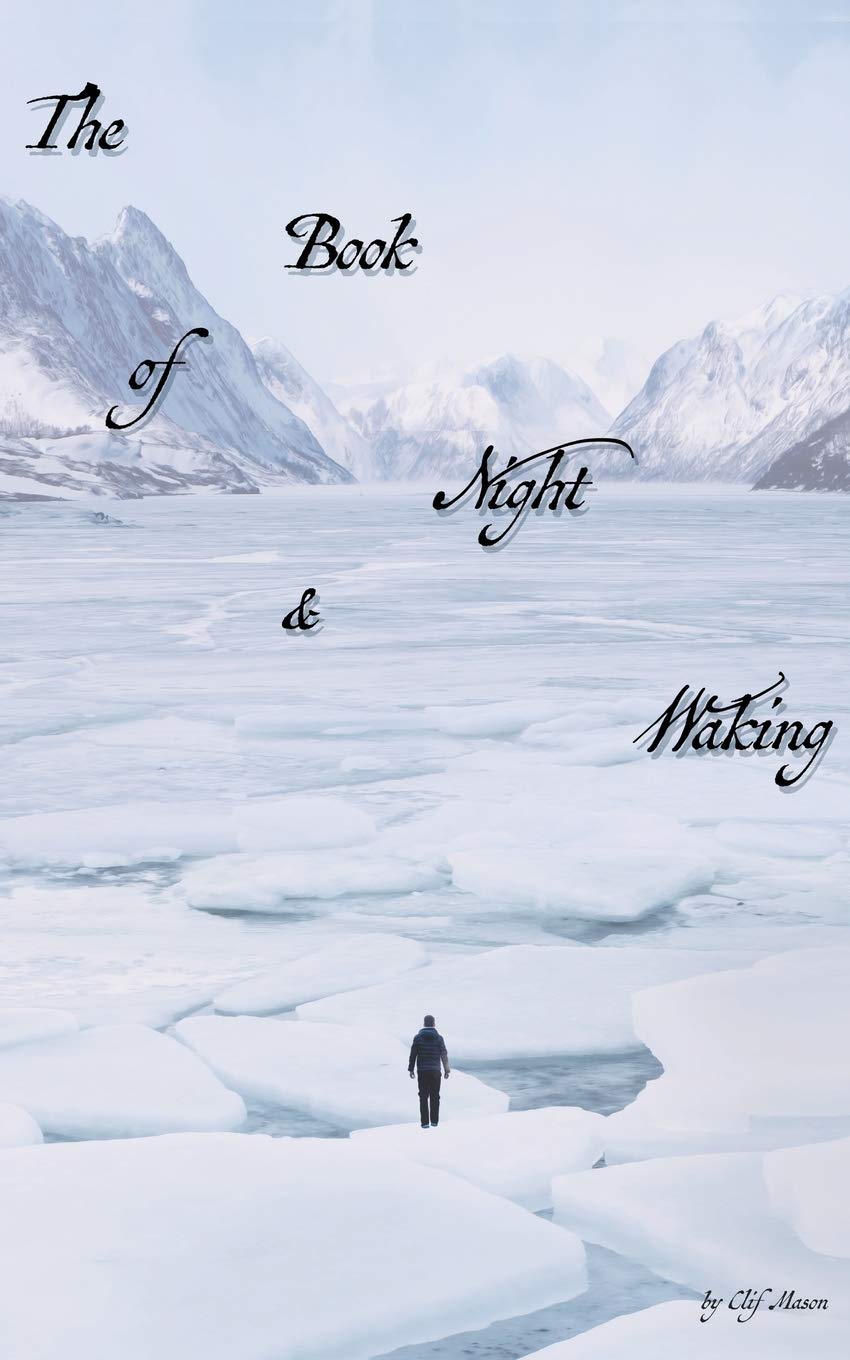
The Book of Night & Waking, my book-length poem, is different in
that it tells a magical realist story of the protagonist, who, despairing
because his country is entangled in war and blackened with grief, sets out to
walk to Antarctica. Along the way, he experiences both great evil (one of the
sections is based on the femicides of Ciudad Juárez, Mexico) and great beauty.
The poem is ultimately an epic love poem, as he connects magically with his
wife (who is not accompanying him) along the way and reunites with her finally
in Antarctica. I found places in the journey for a few poems that had been
published separately (though I revised and re-shaped them for the purpose), but
much of the book is an original composition. This book is also unique in that
it is composed entirely in spaced broken lines that flow down the page.
I know you have interest in fiction
as well. Do you have other books you're working on now--poetry, fiction or
otherwise?
Yes, I’ve completed another full length collection, whose
working title is Tell Me a Story. I’ve selected poems from it to send
out also as a chapbook (provisionally titled Dream Outside of Time). I’m
also taking the draft of a dark fantasy novel that I wrote back in 2010 and
completely rewriting it, based on new conceptions of its narrative
possibilities and new visions of the characters and of the world they inhabit.
I’ve also started writing another novel that will be set in a parallel
universe, on an Earthlike planet called Oceanus, under a black star called
Obsidian. The protagonist of the first novel, a dark priestess named Wing, is a
major character in the second. I love Chinese wuxia films, and I am
planning to include wushu martial arts in the second book, as well as
other fantastical elements.
How many collections do you have out
now and from where? What has yet to be released? Can you describe them for us?
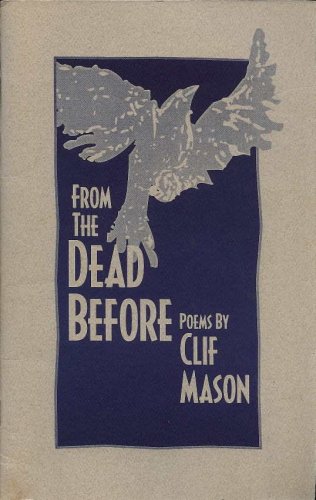
These are my collections: From the Dead Before, Knocking
the Stars Senseless, Self-portraits in Which I Do Not Appear, and The
Book of Night & Waking. The first is no longer in print, as Lone Willow
Press ceased to exist upon the death of Fred Zydek. From the Dead Before
consists of fairly straightforward poems, often about the natural world. The
other three employ natural imagery but are often written, as I’ve noted, in
surrealist and magical realistic modes. Tell Me a Story resembles them
in this way, and one of its sections is composed of magical realist stories. I
have a certain amount of uncollected work from my first 30 years as a writer.
Those poems haven’t fit into the schemes of the collections I’ve fashioned. Should
there ever be a Collected Poems—which is purely hypothetical at this
point—they might find a place after all.
Monday, April 27, 2020
Interview with Poet Clif Mason, pt 3 Technique & Progress
Clif Mason is an English professor and a poet with four collections published. I reviewed his remarkable debut full-length collection, Knocking the Stars Senseless, here and here (part II of the review). Since then, we've been emailing back and forth the following extensive interview on the art, craft life and development of the poet.
This interview is (or will be) in four parts:
One of your stylistic penchants is
the pairing—often novel or unexpected, often tied intimately in image and
sound. Here’s a spectacular one:
There has
been another mass murder
in an
American town.
I try to
expect nothing of flesh or dust
We know immediately what you mean (although sometimes we have to work harder to plot the connections between the sentence/lines/paradoxical pairs themselves. It is simultaneously both amazingly simple and amazingly complex. Here we have images of both life and death that feeds opposingly yet synergistically into the sentence.
How do you settle on a pair? Is it a
tedious process of sorting through possibilities, or is it a natural quirk? Can
you explain this or a pairing that was difficult to settle on?
These pairings come naturally. Some are suggested by
alliteration, some are suggested by image and meaning, as is the case with the
example you quote. If one trusts the organic nature of the process, one has
faith that meaning will obtain. “Depression” is a poem particularly rich in
these pairings, as they flesh out the anaphora that is that poem’s primary
technique. That poem flowed out in a single extended rush. I ended up cutting
some lines and “trainwrecking” in another poem, but the anaphora parts read
very much as they emerged. Some of these make immediate sense, some are still
mysterious to me. An example of the latter is these two lines: “of rust &
riots, rampages & impulse purchases, / of malarial fevers & red planet
hallucinations”. The first of these lines generates speed and momentum and
gives the sense of zeitgeist under great pressure. The second line expands upon
that but in a way that is more suggestive than perfectly rational. I can’t say
that I understand these two lines completely, but I felt they fit the mood of
the poem, so I left them in.
Often neglected in discussions with
poets is the statement. You have a command of imagery, which we expect in
modern poetry, but there’s also the bold statement, the proclamation, memorably
worded. Famously, there’s James Wright’s “I have wasted my life” ["Lyingin a Hammock at William Duffy's Farm in Pine Island, Minnesota”]—that line that
makes the poem peal throughout the images. And of course, William Butler Yeats in “The Second Coming” took on the best and the worst: "The best lack all conviction, while the worst / Are full of passionate intensity."
One of your memorable statement
lines reads:
This is
the age of amputation.
We learn
to live with less and still less.
How does one come up with such
lines? What makes them resonate? Do you have to tinker much with these? Do you
find yourself taking many out, or adding some in? How does/should statement function
in modern poetry?
I am by aesthetic temperament ambivalent about statements
and I try generally to eschew overt didactic statements. That said, there are
statements in my poems. The lines you quote flow directly from the four
preceding lines, which offer images of missing body parts, including a “trunk
of moldering toes.” The direct statement takes these specific images and
creates a larger perspective within which they might gain meaning. The danger
in such statements is that the larger perspective may be a distortion. If such
lines flow out onto the page, one has to pause to ask if they are genuine and
real. If one is at all suspicious of their veracity, they should be cut. In
this case, I felt that the statement reflected something I felt about the
contemporary world, that more and more human meaning is cut away from our lives
by economic and political forces before which we often feel more than a little
helpless. There is certainly a place for the didactic in poetry. Without it, we
wouldn’t have poems like Wilfred Owen’s “Dulce Et Decorum Est,” Adrienne Rich’s
“Rape,” Carolyn Forché’s “The Colonel,” or Rita Dove’s “Parsley”—all of which
are necessary and important poems.
I’m interested in your motifs like
“stars.” Before I understood what you were up to and discouraged you from using
them, did you cut them, did you hesitate, or did you stand up for them,
confident in what you were up to (i.e. “That schmuck doesn’t know what I’m
doing)? Did you take them out and put them back in? When did you realize this
would be an important motif in your works? Did you know what they signified during
the composition of the first poem? or after several poems? or as you were
assembling the manuscript? How do you know what to keep and what to cull?
The incident to which you refer
was when I thought I might be able to use star imagery to link every poem in a
book. I think you were objecting to the surfeit of such images. The word “star”
began no doubt to cloy on the tongue. That was helpful in that I realized it
was perhaps asking too much of a single image to unify an entire book—though
Rilke is able to do it with great power in the image of the angel in Duino
Elegies. The danger was that using stars in this way could become almost a
gimmick. I began as a nature poet, and I realized early on that certain
primordial images—rivers, stars, stones, and trees—were an important aspect of
the way I approached and processed the world. This is probably rooted in my
early years on the family farm and in my high school years in Pierre, South
Dakota—a town in which the Missouri River looms large in the consciousness of
the people who live there. I hope that I use such imagery in fresh and
suggestive ways. So, to answer your question, I certainly took another look at
the poems in which stars figured. I didn’t remove them, as I felt they were
aesthetically justified, but I certainly re-examined them.
As memory serves, can you guide us
through the original stimulus of writing a poem, to composition, to revision
for publication, to revision for the collection? (If pressed for a poem, I’d
say, “Thanksgiving Song” but whatever you have clear in mind is fine.)
“Thanksgiving Song” was originally
titled “Praise Song,” and under that title it appeared in Writers’ Journal.
I had entered it in one of their contests, but the line limit for the contest
was 24 lines and the poem was 45 lines. I had faith in the poem and thought it
might be equally effective if I combined many of the lines. I might say that
I’ve never shied from re-considering the lineation in my poems, as attempting
new line breaks often reveals new possibilities for the poem to make meaning.
The resulting poem came in, as I recall, exactly at 24 lines. In the original
composition, the poem flowed out associatively pretty much as it now reads,
with one exception. A few years ago, I revisited the poem and cut what had been
a whole stanza in the 45-line version of the poem:
Yet the tree frog
wants praise.
Horned owl and muskrat
want praise.
As do red wolf, mule deer,
armadillo, coral snake.
They feel it, know it,
in blood and ravening gut.
The reason I deleted this stanza
was because it seemed flat and prosaic in comparison to the imagery of the rest
of the poem. Cutting this stanza improved the poem. It was at that time that I
changed the title of the poem. I tried further new line breaks, as I felt that
some of those in the 24-line version were somewhat arbitrary. The resulting
poem was 27 lines. It was in long blocks without white space, and I felt it
needed some room to breathe. So, I tried dividing the poem into three-line
stanzas, and that became the poem’s final form.
Lone Willow Press published a very
different chapbook of yours in the 90s. You waited twenty years before doing
another. What was the delay? What made you alter your voice so drastically?
From the Dead Before
was a book that combined some of my free verse nature poems and some of the
formal poems I wrote in the 90s as an attempt to create new possibilities for
my poems. Brad Leithauser’s books Hundreds of Fireflies and Cats of
the Temple were significant influences on my writing at that time, as were
the poems of Marianne Moore, Elizabeth Bishop, Robert Lowell, and Amy Clampitt.
There are a good many sonnets in that collection, as well as a glose (the title
poem). I tried my hand at many other forms in those years, and there was a
sense of adventure and a zest that came from the discovery of the demands and
challenges of received forms, whether it was a pantoum or sestina, a ghazal or
villanelle. However, I stopped writing in received forms when I began to feel that,
for me at least, the form should not be the trigger of a poem. As I’ve already
noted, my poems worked best when words and images appeared in my consciousness
and I allowed them to take shape without loss of their essential mystery. This
is what Keats called “Negative Capability,” which he stated occurs, “when a man
is capable of being in uncertainties, mysteries, doubts, without any irritable
reaching after fact and reason.” He thought Shakespeare possessed this quality
“so enormously,” and I agree with him. I don’t claim to achieve this every time
I write a poem, or even consistently. But I certainly aspire to it.
Saturday, April 25, 2020
Interview with Poet Clif Mason, pt 2 Process & Surrealism
 Clif Mason is an English professor and a poet with four collections published. I reviewed his remarkable debut full-length collection, Knocking the Stars Senseless, here and here (part II of the review). Since then, we've been emailing back and forth the following extensive interview on the art, craft life and development of the poet.
This interview is (or will be) in four parts:
Laura Madeline Wiseman pointed out the walking motif in your poems, mentioning William Wordsworth (not to mention Wallace Stevens). Does this commonly inspire poems or something else? What are some ways you breathe to life new
poems? What do you do when feeling less inspired?
Yes, walking—both in the daytime and at night—is the catalyst
of many of my poems, perhaps most notably in “The Sea Anemone Must Wed
Lightning,” “The Reprieve,” “Culmination,” and “Fantasias of the Falling Snow.”
As far as literary influences go, Thoreau’s essay “Walking,” and Whitman’s
self-depiction as a poet “afoot with vision” in the world have been important,
as well as the examples of Wordsworth and Keats. Walking is, for me, a form of
meditation, sometimes to the point of complete trance-like immersion in the
world around me. I find the rhythm and pace of walking almost perfectly suited to
the creative states of being from which words arise as if from nowhere and begin
to coalesce into poems. The other main way I find the inspiration to write is
to leap almost anywhere into the work of some of the writers I’ve listed above.
Within a poem or two I put the book away, pick up my notebook and a pen and
begin to compose. When I’m feeling less inspired, I don’t write. As Keats said
in one of his letters, “if Poetry comes not as naturally as the Leaves to a
tree it had better not come at all.” Or I use revision of a poem or poems as a portal
into new composition.
You draw equally on surrealism and
reality. When did you begin work that in to your work and what do you feel
surrealism brings to the table?
I read some surrealists early on, in the 70s—James Wright,
Robert Bly, and W. S. Merwin, and a few others, but it was my first in-depth
readings of Lorca, Neruda, Merwin, Rimbaud, Trakl, and Merwin in the late 90s
and early 2000s that propelled my poetry in a new direction. I had read them
cursorily before, but now the full emotive force and electric charge of their
image-making came home to me. I read Lorca’s Gypsy Ballads, The
Tamarit Divan, and Poet in New York; Neruda’s Residency on Earth,
Canto General, and Odes; Merwin’s The Lice , The
Carrier of Ladders, and Writings to an Unfinished Accompaniment;
Rimbaud’s Complete Poems and Trakl’s Selected Poems obsessively,
again and again. I felt deeply emotionally at home in these poets’ imaginary
worlds, in a way I rarely felt at home in the so-called real world. Their poems
lived in the pulse in my wrist, as well as in the impulse in my brain.
Surrealism, at least as practiced by these five writers, profoundly
de-familiarizes language and helps us gain a new vision of what reality might
be and a new alphabet by which to record it.
When did you first feel confident about what you wrote? What remained to be learned?
I don’t mean to sound immodest, but I felt confident about
my writing almost as soon as I began to write seriously—about age twenty. I had
as many clunker lines as lines that pitched steeply up and took flight, but when
the words flew, I knew it and I knew I could become a poet. What I had to learn
was the discipline of craft. I tended to write long, mixing in prosaic lines
with original ones, and I had to learn to cut—ruthlessly, mercilessly—the bad
ones. And I could be a vexingly slow learner. I also had to learn not to write
about something just because I thought I should. I wrote a number of bad poems
in that way. For me, at least, ideas shouldn’t be the origin point of poems.
This is not to say that poems shouldn’t have ideas, but simply that the ideas
should arise organically from the images and sonic intensity of the lines. I
had to learn to eschew the didactic and let the first words of a poem magically
appear in my head and then to nurture and develop—organically,
associatively—the poem, to grow it from those first verbal seeds. Assonance,
consonance, and alliteration came naturally to me—an early instance was “Frog
croak, cricket chatter, / wind keening in the corn blades,” from “Night
Wounds”—and I had to learn how to play with them to increase the verbal force
within lines and stanzas, and how also not to allow a surfeit of such sound
effects to drown my poems. I often pushed the music of a poem to (and sometimes
beyond) the breaking point. I had, in revising, to try to repair the lines
through careful pruning. Finally, I had to learn how to allow myself to
reimagine poems and open myself to radical reinventions of them, often by challenging
and changing their form drastically, and also by “trainwrecking” two or more
poems or poem fragments together. I had to learn to recognize when poems had a common
imaginative origin. I was excited by the new possibilities this practice opened
up for my poems.
If you felt confident at twenty,
what took so long to publish your first book? What were the impediments?
I would never think of them as “impediments,”
as they were all-important to my sense of who I was and who I might be as a
human being, but I would mention three things that kept me from developing as
quickly as I otherwise might have as a writer: working on my Master’s and Ph.D.
degrees in English, and teaching and trying to support a family. During my
graduate studies, I became a bit of a researching, criticism writing machine,
though this metaphor hardly does justice to the work. I found the writing of
criticism both challenging and enormously stimulating, and I became so immersed
in it over time that I almost forgot what it was like to write poetry. Several
years into my teaching career, I tried my hand again at poetry, fitfully at
first. After several years, I gave up writing criticism to focus completely on
poetry. I became obsessive about it. Every day I was reminded how little I
really knew about poetry and especially about writing poems worth reading. I
set out to re-educate myself, and that project is still in motion. I usually
have a dozen or so books of poems that I’m reading at any one time, and I float
back and forth between them, as mood and whim and felt or perceived need
dictate. I began sending poems out to magazines and reaped bushels of
rejections, and a few acceptances, enough to encourage me to keep trying. I was
the faculty sponsor for a little creative writing magazine at the University,
and somehow Fredrick Zydek, a poet from Omaha, discovered us and submitted a
sheaf of poems. We had never published anyone from outside the University
before, but the students liked his poems, so we did. I began corresponding with
Fred and sharing poems with him. He sent me relatively few poems as he was
going through a protracted period of writer’s block, following the death of his
mother. As it turned out, Fred was the Editor in Chief at Lone Willow Press,
and he invited me to submit a chapbook manuscript. I sent him From the Dead
Before, and he published it.
Friday, April 24, 2020
Interview with Poet Clif Mason, pt 1 Beginnings & Influences
When did you start writing?
I wrote a few decidedly juvenile pieces while in high school
(including a wretched imitation of Chaucer’s Prologue to The Canterbury
Tales), but it wasn’t until the summer after my freshman year in college
when I became friends with a young poet. His name was Mark Porter, and he had
been a member of the Classics honorary society, Eta Sigma Phi, into which I had
recently been inducted. Until that summer, I hadn’t really gotten to know him
very well. We both went to summer school and lived in the same dormitory
complex. I learned that he was a devotee of Joan Baez, as well as many other
folk singers and groups, and that he also loved opera and classical symphonic
music. He introduced me to much music I had never heard before, and he shared
with me his translations of Catullus, as well as his own poems. I was struck by
their naturalness of tone and their beauty. His translations compare well, in my
view, with those by well-known translators. The previous year, I had read
widely in Allen Ginsberg and Lawrence Ferlinghetti, among other poets. I had
been listening semi-obsessively to Bob Dylan for several years by then. I was
struck by the surrealism of some of his imagery. The confluence of these
influences and the encouragement and example of my friend (and now mentor) helped
me realize by the end of that summer that I wanted be a poet. That is, I wanted
to be in the world, thinking, feeling, and perceiving, as a poet—and expressing
that existence through words.
Which writers inspired you and what about them fired your imagination?
Their number is, of course, legion. However, if I had to
limit myself to a handful, they would be Sappho, Shakespeare, Keats, Whitman,
Dickinson, Hopkins, Plath, Lorca, Neruda, Merwin, and Clampitt. Sappho for her
passion wed to her incomparable skill. Shakespeare for his vast ocean of
original metaphor, delivered in a startling rhetoric that still leaves me
speechless in admiration. Keats for his peerless lyricism and grace and for his
sense of himself as an artist. Whitman for the breadth of his human compassion
and for the robustness of his interest in the world around him, both the world
of nature and of the city. Dickinson for the depth and genuineness of her (sometimes)
melancholy and for her fearlessness in detailing it. Hopkins for the bold force
of his poems’ sonic effects. Lorca for his tragic sense of life, expressed in a
baroque language and surrealism that always leaves me in a state of wonderment.
Neruda for his supremely fertile surrealism and for the depth of his
imaginative involvement in the lives of the working class. Merwin for the
stunning originality and power of his surrealism, delivered in the most simple
and straightforward of language. Clampitt for the lush zest of her language and
the precision of her knowledge of the natural world. I believe that, among
contemporaries, she is the closest we have to Keats. Of course there are
innumerable others I might mention—Homer, Virgil, Dante, Coleridge, Christina
Rossetti, the Eliot of “Prufrock” and Four Quartets, Georg Trakl, Marianne
Moore, Elizabeth Bishop, Dylan Thomas, Wallace Stevens, Paul Celan, Theodore
Roethke, James Wright, A. R. Ammons, James Dickey, William Stafford, Denise
Levertov, Gary Snyder, Anne Sexton, Ted Hughes, Adrienne Rich, Rita Dove, Mary
Ruefle, Matthew and Michael Dickman, Natasha Trethewey, Lee Ann Roripaugh, Ilya
Kaminsky, Joan Houlihan, Nick Flynn, Diane Seuss, Jericho Brown, Aimee
Nezhukumatathil, Ada Limon, Kaveh Akbar, Ocean Vuong, Tiana Clark, and Joseph
Fasano are a few. And this is not even to mention the long list of the Nebraska
poets—the late William Kloefkorn and Ted Kooser and an array of other exceptional
living contemporaries. But I’ll leave it at my original list.
Who are some of your mentors--in
person or otherwise? What did you take away from them?
My college friend, whom I’ve already mentioned. Some of my
English teachers, such as William and Dorothy Selz, Thomas Gasque, John R.
Milton, Gervase Hittle, William Lemons, and Paul Pavich, from the University of
South Dakota, and Linda Ray Pratt, Bernice Slote, Louis Crompton, Walter Wright,
Elaine Jahner, Fran Kaye, Charles Stubblefield, and Paul Olson from the
University of Nebraska-Lincoln. Each of them offered me an intense appreciation
of particular writers or literary periods and helped deepen my commitment to literature
as a way of both knowing and recreating the world and to criticism as a way of passionately
experiencing literature in one’s nerves and synapses and of taking action in
the world. I would be utterly remiss if I did not mention three other
significant mentors from USD: Nancy Skeen, my philosophy teacher, who
introduced me to the love of ideas and the desire to continually pursue the
truth of things, even if that truth remains elusive; and Helen Fremstad and
Frederick Manfred, my two creative writing teachers. Their approach was one of
deep encouragement of what was best and fresh and distinctive in each of their
students’ work, without imposing their own predilections. A writer who also
studied with Manfred at the same time I did was the novelist Michael Doane, who
primarily wrote poetry then. The well-known novelist Pete Dexter also studied
with Manfred, as did my friend, Mark Porter.
Monday, March 23, 2020
Review: Knocking the Stars Senseless by Clif Mason (II)
Part II
This recurring theme [that beauty can enlighten tragedy] returns
in “Ghost Music” as it deals with the speaker’s loss of his father: “The
singing tongue is cut from autumn’s river.” In essence, Mason’s speaker asks us
in his songs: How can we keep singing
when the world is full of pain? The answer comes, through much pain, at the
poem’s end:
Wind picks his pocket again as he
ambles.
It steals again sweat from his
body, music from his ears.
It takes again the gait from his
legs, the taste from his tongue.
The more it steals, the less he
feels bound by gravity.
He laughs as the wind bears him off
like a kite.
When I critiqued his poems, I often slammed Mason’s use of
“stars” in his poetry as I’d seen too many awful poems written with that in
them, but through judicious use and careful building of his motif, he’s made
the stars his own. It is in the book title and the titular poem, after all. And
it’s cleverly deployed, to boot. The stars could be incandescent dots that
candle the night, or those whom society reveres, for whatever reason, or the
heavenly afterlife (“to drink from the stars’ chalice / the black anodyne of
sleep.”—“Fugue for the Sandy Hook Dead” or in “I Wore the Night Like a
Roquelaure” where when a grandmother passes, the speaker’s song becomes “the
new star of resolve / in her brain’s core.” That last poem, especially at its
titular moment, seems to be the transformation of the speaker who turns grief
into something transcendent.). And “senseless” could be unconscious or a lack
of meaning. All of these senses fuel Mason’s poetry. (Am I eating crow? Very well, I eat crow.)
In “The Sea Anemone Must Wed Lightning” Mason writes of
suffering as a thing we carry, perhaps belongings we should value:
What can I say of this suffering,
except that it is mine? I will
carry it
into autumn, holding it over
my head as, crossing a river,
I would a bundle of clothes.
Later, the speaker sings what he wants songs to do:
I want the song that will lift
the moon’s white bone back
into its black socket. I want the
song....
that will raise a fallen
child, if only for a day
The final poem, “Thanksgiving Song,” refines this idea of
song (brought up in “I Wore the Night Like a Roquelaure” – discussed above) as
the magic that words carry in them and the magic that we carry within us:
I can sing with the broken bone
of the yellow half-moon....
Each name sings
light needles into ebony dusk....
we are all
yes, each & every one, the last
least, best unexpected thing.
This poem—with a few rivals for being the best in the book—deserves
to be anthologized in a dozen or two good anthologies. Poet Patrick Hicks also
singled out this poem. Forgive the excerpt as only the whole poem can do it
justice.
Judith Sornberger writes that his work is “Incantatory as
Whitman” which you’ll find in a poem like “Depression”:
All the harvesters are falling
apart, shaking & shuddering
& collapsing before they can
leave the fields.
All the luxury automobiles are
falling apart
in garages & shops & on the
street
All the bridges & skyscrapers
are falling apart
falling to rust & poisonous
dust & bent & sheered rebar.
These excerpts and examinations should more than adequately
suggest why you should acquire this book for yourself (or get your library to
do so, if you cannot afford it).
What makes these poems stand out above most contemporary
poetry: His poems tell you why you should read them. The images and sounds—even
interesting philosophic content—suck the reader in. Not the particular
political stance as if poetry were more about politics than aesthetics
(although, yes, Mason toes the line of the politically correct), not the surreal
inscrutability (although, yes, Mason uses some of that), not a bolus of images that
are hard to swallow (although, yes, Mason’s imagery astounds and confounds),
but he uses his silvery tongue to get us to leap after, to travel to this
strange land we tread upon and intriguing scenarios, or some other spark of interest
to keep us reading and rereading.
For example, “Darkfall” opens with intrigue and mystery:
For centuries we seeded the cemeteries
so it was no surprise the soil
grew nothing but headstones.
How can those lines not get one to read on? This is part of what
makes this book rise above its peers. If poets and poetry readers aren’t flocking
to this book this year, then there’s too little justice in the world, but at
least it exists and we the lucky, who have read it, can lift it over our heads
as if crossing a river and call on others to hear these songs.
Friday, March 20, 2020
Review: Knocking the Stars Senseless by Clif Mason (I)
Clif Mason and I met at a poetry workshop, not quite a decade ago, and he was an excellent poet then. An English professor and Dean of Humanities, he is gentle, soft-spoken and rounded out by insight. This is a man who writes poems whose speaker stands before a stuffed otter in a museum and mourns its passing (see “The Otter”).
What poems was he workshopping? If you have Knocking the Stars Senseless in your hands, then you have some of them. I have the sense that he’d been working on these poems long before we saw them. He kept working on them after they were published.
So when I read people being amazed at Clif Mason’s suddenly being “prolific” because he has had three different poetry books released from three different presses within a year, I feel his pain. He has been agonizing over these for perhaps more than a decade—a handful maybe twice that. So prolific? No.
He wasn’t just adding and removing commas, either. Merciless as Ming, he’d quarter poems to stubs or stretch them on the rack beyond their original form. They’d appear in form, aligned as a stone army, and be stripped out of uniform to throw them into cubist arrays. He was tireless in his revisions.
I review books—of friends, strangers and people who chose to be enemies—as subjectively as possible. There are nigh glowing reviews here of people sharpened themselves into daggers and sweet dismissals of candied personalities. I try to review as if I’m friends with the reviewee and the people looking for good books to read. As a matchmaker, I don’t want to let either down.
Moreover, Mason’s voice is a new voice that needs to be heard. Have you devoured the sounds of Ocean Vuong’s words? Does your heart quicken at the submerged wisdom and surreal images carved by W. S. Merwin? Then savor Clif Mason because their sauces flavor his volume’s stew. Until I read the other two volumes, I’m not yet willing to concede that he is a major writer—he may be, but time will have to decide that, anyway. I will say that his voice (not to mention this volume in particular) is one that needs to be reckoned with.
To get a sense of the book’s trajectory, peer into the opening prose poem, “Double Narrative: This Waking Life”:
When I yearned for the incense of candle & canticle, I sought the fulcrum of trance & tragedy, hawk & hook.
The book I wrote unwrote itself as I typed. Characters disappeared as if kidnapped.
This is both true in his personal life and in the larger world. The personal, literal truth is how, as I mentioned earlier, the book has gone through its own radical changes, but in the larger sense Mason laments violence—such as Sandy Hook and Auschwitz—where people did “disappear,” lives brutally brought to an end. He writes in “Day of the Dead”: “Have you found the trunk of moldering toes? // This is the age of amputation // We learn to live with less & still less.”
“This Waking Life” from the title has its own double hook. “Waking” suggests that we are awake, but also that we are still asleep, in need of being roused—a perpetual state.
In “Nightwalk in the Republic” the poem is more or less a palindrome of lines—the same forward as backwards, except for tiny alterations you have to pay close attention to. The speaker fears sleep as the news of another mass shooting torments his dreams—a perfect scenario for this poetic form. The opening/closing change are perhaps the most potent. It opens (I had to stop myself from quoting more—just one thing, you said):
Owl calls on a cold night—
solemn, commanding hoots.
I wander, lost, full of midnight’s wanderlust
and closes:
as I wander, lost, full of midnight’s wanderlust
& command solemn hoots
from the owl calling on a cold night.
Note the owl, in the first instance, lacks an article (a, an or the), which makes it more mythic—a name, perhaps—the owl of all owls, the god of owls, the original progenitor. The owl could be a symbol of wisdom or of its power, its predatory nature. Perhaps both.
(All of the above do seem to apply. The poem “Insomnia” confirms and further sketches the owl’s nature: “Night is the owl’s kingdom....//The owl rules the world of shadow & hazard.”)
The owl “calls on” which could be a simple sound, or it could be visiting or asking help from the cold night. The commanding hoots helps determine its powerful intentions, hinting at a supernatural nature that gets the night to do its bidding.
When we return to these images, the speaker now commands. He is no longer powerless, but his powerlessness, his lostness, his lust for midnight’s wandering have become a kind of power as he demands the owl to call. Given the voice, we assume he can do this in this transformation although one is free to question that ability. We would have two very different poems, depending on which one chooses.
Strangely, both do seem to apply to the situation. This duality applies to the opening poem (seen above, such as the “candle & canticle, fulcrum of trance & tragedy, hawk & hook”) and throughout the book. The poet sings in a beautiful melancholy voice as he raises a candle to shed light on our place in the world. It is a fine balancing act since it calls on beauty to enlighten our tragedies.
Subscribe to:
Posts (Atom)