Search This Blog

Showing posts with label Kazuo Ishiguro. Show all posts

Monday, April 15, 2024

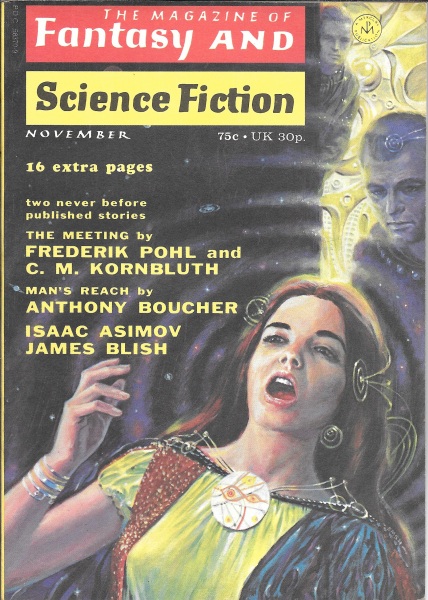
"The Meeting" by Frederik Pohl and C. M. Kornbluth

https://www.isfdb.org/wiki/images/2/2a/FSFNOV72.jpg

First appeared in Edward L. Ferman's F&SF. It won a Hugo and was up for the Locus. Reprinted by Lester del Rey, Terry Carr, Isaac Asimov, Fred D. Miller, Jr. and Nicholas D. Smith. Selected by James Frenkel as one Pohl's best. 


Summary:

Harry Vladek attends meetings about "Exception Children" to seek advice from professionals about what to do to help his child. He and his wife are faced with a difficult decision about what to do with their child who lacked normal developmental progress.


Discussion and Analysis with Minor Spoilers:

Most readers will need to read this two or more times. Part of this is that the story doesn't reveal what's at stake until the end. The other part is that it is carefully written.

James Frenkel writes that this story:

"is a a thoughtful, challenging story about a modern dilemma with no easy answers."

Context:

About a century ago, relatives in our own family had a couple of children with learning disabilities. They traveled across the country to various "experts" who claimed they could help their kids. Without success. They hired private tutors who struggled in a manner that made the parents let the tutor go.

This would be some of the difficulties parents were facing a century ago and, to some degree, when this story was written.

In 1964, Congress passed Economic Opportunity Act of 1964, which included Head Start program. In 1975, Congress passed the IDEA or the Individuals With Disabilities Education Act. Moreover, Roe v. Wade is making its way to the Supreme Court. The year this story won the Hugo, Roe V. Wade became an important if controversial ruling that lasted five decades.

Within these barriers, this story exists, and for my money, it's a powerful glimpse into the challenges parents might have had in this extrapolation. Who knows? It might still lie ahead.

This has uncanny parallels to Kazuo Ishiguro's Never Let Me Go, but the narrator here doesn't direct us toward feeling a certain way toward the decision, facing our protagonists (although the decision and perspective here is firmly in the parents' point of view). Of course, the lack of compelling the reader toward any perspective neither necessarily makes it a better story nor does it necessitate that the readers have no perspectives of their own. Moreover, a reader does not have to side with an author, but there is power in this story for not taking a side. Perhaps it helps to step into the protagonists' shoes.

Some extrapolation may be required, but the story has relevance for today. Even if it hadn't, place within context, it should remain a powerful tale worth reading.

Thursday, July 8, 2021

"Educational Tapes" by Katie Livingston (edited / expanded)

First appeared in Writers of the Future 36, edited by David Farland.

Told in an adventuresome second person, this dystopian tale presents a speaker advising? reeducating? training? another on navigating its world through "educational tapes."

Comment with some spoilery bits:
This is a pleasant surprise to find an experimental piece in Writers of the Future. In the past the anthology series has been staunchly traditional. 

What makes it experimental are a number of factors:
  1. The nonfiction voice--told mostly in an informational tone
  2. The protagonist (or "you"), often considered a problematic choice (see below)
  3. The speaker. Who is it? A group or individual? Do we trust them or not?

Factors two and three make the process of uncovering fun. What this method is, gets revealed toward the end, which suggests the "why" to an extent. This was well executed although it means you have to read it at least twice (or thrice).

The "you" is a problematic choice [in general, not necessarily here] because readers don't know to whom it refers. 1) the speaker? 2) the listener? 3) an actual character who is being spoken to, or 4) some abstract everyman. In poetry this works well, probably because the spaces are much shorter, the readers more willing to bridge gaps, and the lack of their expecting narrative. One can maintain one or all possibilities at once. In fiction, we have characters that we expect to be filled out. As the character fills, the less likely all options can be maintained. "Okay," the reader says, "I know this character isn't me because..._____," etc.

The educational tapes add another layer to the puzzle. When and where does this take place? In the past when tapes were a commonly used technology? In the present or alternate present but in a technologically retrograde country? In the future scrabbling to reacquire technology? In the future but with some new technological sense of "tapes"? I don't think this gets answered although I may be wrong.

For my mileage (yours may vary), the experience could have been a wee bit more immersive in terms of storytelling (factor one)--what John Gardner called the fictional dream, vivid and continuous. I wouldn't insist on the continuous as the narrative voice here is essential and you wouldn't want to spoil that. Judith Slater's story collection, The Baby Can Sing, I thought did a good job at this.

Despite the numbering of tapes, there's little sense of order or progress, apart from the reader's gradual understanding. Since narrative necessarily prolongs the telling, maybe that was why the author kept it minimal. It might have grown too long. However, this seems to beg to be a novella. 

With any experiment--speaking as one who likes reading and writing experimental fiction--it's better not to hide everything. Make it feel like you've shown your hand. See Kazuo Ishiguro as an example although you could point to Samuel Beckett as a counter-example.

I'm not sure that the story answers all the questions it raises. For example, despite resolving the "you" issue quite well, I'm still not sure if the speaker is reliable. The story may answer all questions. I may need to reread it a few more times to know (I wasn't sure at first that it answered factors two and three above, but it did). That it invites such interrogation makes it worthy of inclusion and rereading. I may or may not report back later. A toast to the author. Well and subtly done.