Search This Blog

Showing posts with label Lewis Carroll. Show all posts

Tuesday, March 19, 2019

Banned Books: Black Spring by Henry Miller

Image result for Black Spring by Henry MillerI wanted a comparison of Tropic of Cancer (previous commentary) to Black Spring. Is one better than the other? They're both written by the same guy with a similar stylistic verve, yet one can see why one book might be preferred. Tropic of Cancer has a more personal feel, but it is also grimier. Black Spring has subject headings. I read someone call them stories, but I'm not sure they're that. If you take “The dreamers dream" quote below, it is a complete paragraph. It could stand alone, or be lumped with another "story" entirely. I suspect that one inspired another, yet I also suspect a completely new book could have been achieved by reshuffling. Perhaps Tropic of Cancer could have used an organizing principle, even if the organization were arbitrary. I'm sure academics have staked their careers on the organization.

It seems to me my initial impression was correct, in terms of savoring a passage and setting the book down. A movie will never be made out of his books*--or  at least not a faithful one based on the events since what are the events? Moreover, this book quotes and structurally a kind of Lewis Carroll's Alice-in-Wonderland surrealist logic. There is a dialogue but it doesn't feel like a real one (see the last quote). No, Miller may best read as a prose poet, as a writer of passages, as etcher of lyric essays. The books may cohere as a poet's as well. Note that Lawrence Ferlinghetti quotes Miller for the famed title of his collection, A Coney Island of the Mind.

Opening a Miller book is like opening a box packed with poets' toys. Karl Shapiro called Miller's work wisdom literature, and in some cases as in some of the quotes below, I believe he's correct.

Cool Quotes:
"I do not have to look in my vest pocket for my soul; it is there all the time bumping against my ribs, swelling, inflated with song."


“The dreamers dream from the neck up, their bodies securely strapped to the electric chair. To imagine a new world is to live it daily, each thought, each glance, each step, each gesture killing and recreating, death always a step in advance. To spit on the past is not enough. To proclaim the future is not enough. One must act as if the past were dead and the future unrealizable. One must act as if the next step were the last, which it is. Each step forward is the last, and with it a world dies, one’s self included. We are here of the earth never to end, the past never ceasing, the future never beginning, the present never ending. The never-never world which we hold in our hands and see and yet is not ourselves. We are that which is never concluded, never shaped to be recognized, all there is and yet not the whole, the parts so much greater than the whole that only God the mathematician can figure it out.”


"She's got millions of them inside her and they're all whirring around in there dying to get out. Whirrrr ... whirrrr. And if you'd just put a needle inside and puncture the bag they'd all come whirring out... imagine it... a great cloud of soul-worms... millions of them... and so thick the swarm we wouldn't be able to see each other.... A fact! No need to write about China. Write about that! About what's inside you..."

* Bold proclamation that has already turned out to be untrue after a few minutes. He's had four or five, but none of them are especially well received. This one for Tropic of Cancer got a 71 tomatoes from critics, 25 from the lay audience, and a 5.7 from IMDb, which rounds out to a so-so movie. The others, linked to here when the post is finished, fared slightly worse, but still within the so-so range. I do think Black Spring would be particularly difficult to film, so I won't edit out the statement. I don't see how a movie can capture Miller's strengths as a writer.

I discuss two other Henry Miller novels:
  1. Tropic of Cancer and
  2. Quiet Days in Clichy (his most filmed).

Thursday, April 20, 2017

On Dreams, Song, Alice, and a Lewis Carroll Poem

"A Boat Beneath a Sunny Sky" or "Of Alice in Wonderland"

A boat beneath a sunny sky,
Lingering onward dreamily
In an evening of July —

Children three that nestle near,
Eager eye and willing ear,
Pleased a simple tale to hear —

Long has paled that sunny sky:
Echoes fade and memories die:
Autumn frosts have slain July.

Still she haunts me, phantomwise,
Alice moving under skies
Never seen by waking eyes.

Children yet, the tale to hear,
Eager eye and willing ear,
Lovingly shall nestle near.

In a Wonderland they lie,
Dreaming as the days go by,
Dreaming as the summers die:

Ever drifting down the stream —
Lingering in the golden gleam —
Life, what is it but a dream?

*

This was Poetry Magazine's poem of the day last week, and the last line struck me as familiar. Ah, but of course: 

Row, row, row your boat, 
Gently down the stream. 
Merrily, merrily, merrily, merrily, 
Life is but a dream.

Wikipedia lists this song's first printing as 1852 (although it was possibly in existence before that). Which came first? Was he the originator or merely referencing the song? Carroll would have been 20. Possibly the phrase predated both. Carroll references Alice in Wonderland (published 1865 although he'd written earlier versions prior it's first printing. 1862 is listed as the date he first orally told the tale, so he had to have at least written that--likely later than 1862, then. Bartleby suggests the poem's first printing was 1895 under the above alternate title.

Carroll may have been referencing that song although it is an American song, which hampers that possibility a bit. However, if the poem was composed nearer 1895, then Carroll's likelihood of hearing the phrase from the verse seems probable.

When you hear "Life is but a dream," what does that mean? In "Row Your Boat", the use of "gently" and "stream" and the repetition of "merrily" four times (not to mention the lilt of the song itself) suggests that the song presumes "Life is unbearably wonderful." Is that wishful or hopeful thinking, or indoctrination of young minds? Who thinks of life being a dream? Beyoncé? At least she had a documentary called that. Songwriters in the fifties released sugar-coated songs with that title. It just seems odd or perhaps someone was born extraordinarily lucky and/or rich.


Carroll's use of the phrase seems quite different. His interpretation adds a bittersweet flavor, especially if it were composed so many years later. The persona's voice sounds wistful for the time he rowed the young ladies out ("Lingering onward dreamily") as well as for the Alice of the tale ("Still she haunts me"). Throughout, he mentions the end of things: evening, frost, Autumn, not to mention "Echoes fade and memories die").

In fact, he equates the dream with Alice herself: "Never seen by waking eyes." So a tale is a dream. When Carroll gets to his final line, he references the old song's blind devotion to believing life is unbearably wonderful, but ties to that idea that life is fleeting and story-like, perhaps due to the uncertainty of memory.

Interestingly, the poem that references a song became another song, which seems to mirror the moods mentioned here. The song (or poem?) is apparently famous enough to get riffed here and here.

Friday, February 21, 2014

The Voice of the Children's Author

One of my chief pleasures in reading children's books is the authorial voice (or the book's storyteller voice), which tends to be different from adult books. I've examined a few favorite books to help nail down what it is.

Funny/Odd Character Names:
In Roald Dahl's Charlie and the Chocolate Factory, the grandparents' names match: George and Georgina, Joe and Josephine. In Neil Gaiman's Coraline, we have Miss Spink and Miss Forcible. Sometimes the other characters have odd names but not the protagonist.

A Childlike Voice of Amazement
The voice may use "huge" or "very" (Neil Gaiman in Coraline) or otherwise verboten adverbs and simple words of aggrandizement (Dahl again):
"The house wasn't nearly large enough for so many people, and life was extremely uncomfortable for them all.... The bed was given to the four old grandparents because they were so old and tired. They were so tired, they never got out of it."* [emphases mine]

*The Absurd, Odd or Surreal Not Remarked upon
Note there's one bed for four people, two married couples in one bed in which they stay all the time for being tired. I first noted this in L. Frank Baum's Ozma of Oz as a child. Why isn't the character or storyteller more amazed?:
" 'Over to those trees, to see if I can find some fruit or nuts,' answered Dorothy. 
"She tramped across the sand, skirting the foot of one of the little rocky hills that stood near, and soon reached the edge of the forest. 
"At first she was greatly disappointed, because the nearer trees were all punita, or cotton-wood or eucalyptus, and bore no fruit or nuts at all. But, bye and bye, when she was almost in despair, the little girl came upon two trees that promised to furnish her with plenty of food. 
"One was quite full of square paper boxes, which grew in clusters on all the limbs, and upon the biggest and ripest boxes the word "Lunch" could be read, in neat raised letters. This tree seemed to bear all the year around, for there were lunch-box blossoms on some of the branches, and on others tiny little lunch-boxes that were as yet quite green, and evidently not fit to eat until they had grown bigger. 
"The leaves of this tree were all paper napkins, and it presented a very pleasing appearance to the hungry little girl."

Stating the Obvious (or the Obvious from a Childlike Perspective)
Sometime the voice tells us what we already know (Neil Gaiman in Coraline), which is part of the charm (is it because nothing should be taken for granted?):
"It was a very old house--it had an attic under the roof and a cellar under the ground."
 Here's a famous Lewis Carroll line that some may or may not take to be true, yet it has a certain ring of truth even if you don't agree:
" 'What is the use of a book,' thought Alice 'without pictures or conversations?' "
 ***

I doubt this is any way complete, but it's what strikes me on a quick revisit of old favorites.

Thursday, September 5, 2013

Jane Yolen [and Lewis Carroll] on sense, sound, moral and the reader

[Quoting Lewis Carroll:] " 'Tut, tut, child!' said the Duchess. 'Everything's got a moral, if only you can find it.' "
and 
“Take care of the sense and the sounds will take care of themselves.”
and 
“[I]t's ridiculous to leave all the conversation to the pudding!”
and 
“When I use a word,’ Humpty Dumpty said in rather a scornful tone, ‘it means just what I choose it to mean — neither more nor less.’ 
" 'The question is,’ said Alice, ‘whether you can make words mean so many different things.’ 
" 'The question is,’ said Humpty Dumpty, ‘which is to be master — that’s all.” 

[Yolen:]  "I have tried to be master in these short stories.  I am sure they have morals somewhere.  I took good care of the sense.
"The rest is up to the readers--you, dear puddings."
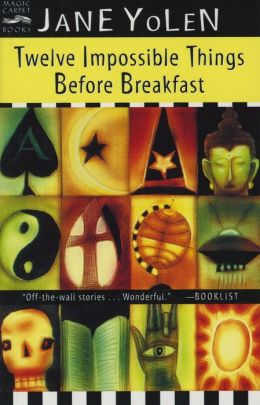
from Twelve Impossible Things Before Breakfast by Jane Yolen

[Note:  I cut out one she did not refer to and extended the quote on another which I found of note.]

Tuesday, September 3, 2013

Jane Yolen on the reading and writing of fantasy

[Quoting Lewis Carroll:  Alice said:] "[O]ne can't believe impossible things."
 "I dare say you haven't had much practice," said the Queen. "When I was your age, I always did it for half-an-hour a day. Why, sometimes I've believed as many as six impossible things before breakfast."
[Yolen:]  "The reading of fantasy and the writing of it take that kind of practice, too."
from Twelve Impossible Things Before Breakfast by Jane Yolen