Search This Blog

Friday, June 13, 2025

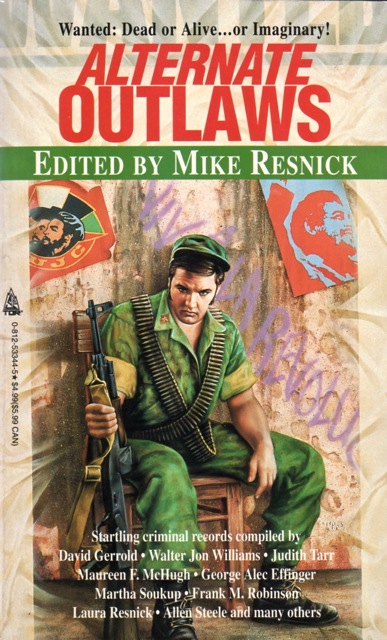
"Good Girl, Bad Dog" by Martha Soukup

 https://www.isfdb.org/wiki/images/8/8e/ALOT1994.jpg

First appeared in Mike Resnick's Alternate Outlaws


Summary:

This is the kind of story that begins in confusion, and it requires the reader to work it out. All I will say is that a boy and a dog get lost. 

Discussion (minor spoilers):

 I very much do not want to spoil this. Do read it if you can find it. If her other other stories sound interesting, you can find it in her one collection. If not, hunt down a used copy of the Resnick anthology.

The following make the opening confusing: 

  1. Who are the characters? 
  2. Who are the characters in relation to one another? 
  3. How well do they understand each other?

The story is told from the point of view of a famous dog who wants to change his life, to go wild. However, he's spent so much time as a dog of fame, that it is initially hard for him to adjust. The characters don't understand one another well, despite having some sense of each other. The dog does make a change--a rather surprising one.

This is a very different perspective from her story "Dog's Life," and serves as an interesting contrast. 


Wednesday, June 11, 2025

Martha Soukup appearances on the Internet

To round out one's understanding of a writer who has become more elusive the last few decades, here are some appearances from elsewhere:

#

Discussion of Stories (if a link isn't working, then that story discussion will be out shortly):

  1. Over the Long Haul
  2. A Defense of Social Contracts
  3. The Spinner
  4. Dog's Life
  5. Good Girl, Bad Dog
  6. The Arbitrary Placement of Walls
  7. The Story So Far 


#

Salon articles from the early 2000s

Her work does seem politically driven as the other samples also seem to suggest.

#

Anti War sentiment presumably from a similar era but it feels a bit like the 80s:


#

Clips from a sample of her plays:


Tuesday, June 10, 2025

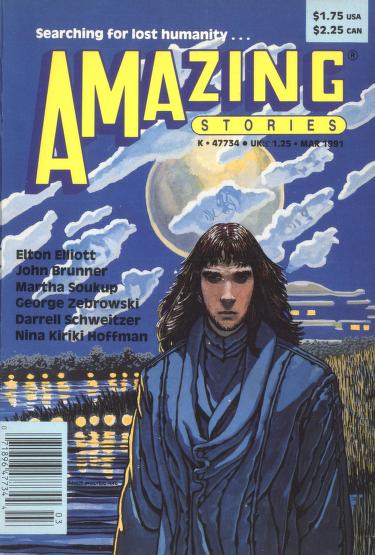
"Dog's Life" by Martha Soukup

https://isfdb.org/wiki/images/9/9d/AMAZMAR91.jpg 

First appeared in Patrick Lucien Price's Amazing Stories. Up for the Hugo, Nebula, and Locus awards. Reprinted by Fred Patten.

Summary:

 Herb, a large beige dog, and Wayfarer, a Siamese cat, demand independence from their owners.  The owners bristle since they feel they haven't been bad owners, but Wayfarer says:

"The time for talking is through. What reason is there for four-footed animals to be subservient to two-footed? It's slavery."

The pets walk out, but life is more difficult than they expected--at least, than Herb expected.


Discussion (with Spoilers):

 Utterly charming. 

I was curious about the lack of the article "a" in the title. The phrase "a dog's life" originally meant a subservient one living off scraps (circa the 17th century), but I've heard it used in the sense of a life of indolence/laziness, often in a jocular sometimes derogatorily or admiringly manner. This may have more to do with how we've changed our attitudes toward pets over time. 

This change in usage is also observed in the story. The dog starts out with a life of ease but without independence. He gains independence but endures hardships in the phrase's first usage yet ends up with independence and a life of ease--the more contemporary usage.

Is it something more? I've puzzled over this. There may be something I've missed. Perhaps it could parallel human independence from whatever system we labor under, but if so, the point of the target isn't clear, or else it is merciless toward all parties. Or it has no application toward human systems, just an amusing extrapolation if pets gained language skills and human-level sentience and started using these.

Is this how pets would talk? Possibly. Possibly not. But amusing, nonetheless. 

Not a major work but definitely a pleasant encounter. 

Sunday, June 8, 2025

"The Spinner" by Martha Soukup

 https://m.media-amazon.com/images/G/01/ciu/11/60/bd21619009a07435cf7d4110.L.jpg

 First appeared in Jane Yolen's Xanadu 2.

Summary:

Rianna, "The Spinner," can spin anything into yarn--from wool to dog fur, from flax and seed pods to horse manes. 

Then one day, a woodcutter named Rowan comes into her place and asks for her to spin so that he can have gold to win the hand of his girl from her father.

Rianna agrees, and for awhile all parties are happy. However, the arrangement seems to change.


Discussion:

 Rowan suggests that he may or may not be engaged and so they make love. But he disappears until Rianna hears of his impending marriage. She decides to ruin it for bride and groom, using her magic to bind him only to Rianna.

This feels like a retelling of the Rumpelstiltskin story from the viewpoint of the Rump--the man who in exchange for gold attempts to ruin a family by taking the first born, as was promised. However, Rumpelstiltskin does give the couple a chance to win back the baby and restore the marriage.

Here, Rianna is wholly successful. It's hard to say what to feel. Surely, instead of one sad person, we have three (and those who are sad because these are). It's quite a bitter and pointless revenge since if she actually loved him, then she would be just as sad and miserable for the rest of her life, too. If she didn't love him, then why bother?

Or are we readers supposed to feel the revenge that the secondary character deserved rather than a man who happened to fall in love more than one person (at least for a moment)? Or is it simply wish-fulfillment revenge for every woman who felt wronged, without contemplating the consequences that will ruin everyone involved? It is strange that we go from seeing the protagonist as someone we care for to someone who appears bitter and vengeful, someone we hope we never meet.

This story requires a little context. "A Defense of Social Contracts" [link for discussion] is that necessary piece.

In her comments regarding "A Defense of Social Contracts," Soukup discusses how she wanted to write about how obsession feeds into revenge than loops back to obsession (a story with "fantasy" notion). Perhaps that describes this a bit if not a perfect fit. However, obsession and revenge do seem to factor into some of her stories. It suggests, too, that theme or perhaps certain observable human patterns may come first that she wants to illustrate within a narrative frame.

Like Rumpelstiltskin, Rianna disappears although in some versions, Rumpelstiltskin tears himself in two. Perhaps there was a reason for that revision.

Friday, June 6, 2025

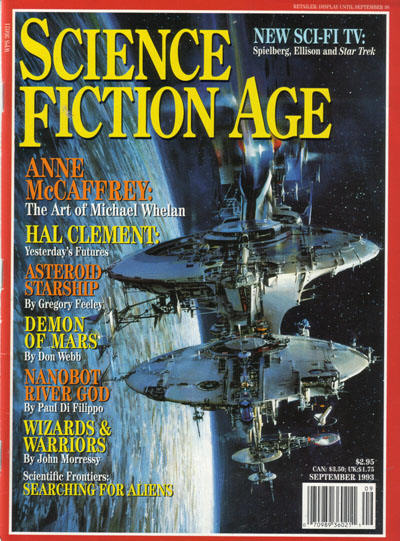
"A Defense of Social Contracts" by Martha Soukup

First appeared in Scott Edelman's Science Fiction Age. Reprinted by Pamela Sargent. Won the Nebula, up for the Tiptree awards.


Summary:

In a world that has idealized and perfected social contracts and licenses for every potential kind of love, with some crossover, Derren and Anli meet and begin a relationship with very different expectations--despite the supposed clarity of their situation.


Discussion with Spoilers: 

Anli knows Derren is nonmongomist, but that doesn't deter Anli from trying to maneuver him into a committed relationship--so much so, the story ends in tragedy, in as much as a perfect society could have a tragedy.

The best story to contrast this with would be Frederik Pohl's "Day Million." Both spend most of their time telling the story more than the standard story. 

The second and perhaps primary thing to pay attention to is the narrator's voice--both of which look down their noses at those who might disagree (although Soukup's narrator assume you'd agree). Though we feel for the situation Anli put Derren into, a number will also feel for Anli. While some readers may have zero sympathy for Anli, more than a handful may feel for her attempts to get Derren into an exclusive relationship. Unlike Pohl, everyone on the planet knows someone (or is someone or has received overtures from someone) who tried to force another into a relationship the other party didn't want.

That it won a Nebula people can debate, but it is a worthy candidate. Is it a classic? Again, one might debate its merits, but if Pohl's is a classic, then surely this is, too, being more complex. 


Wednesday, June 4, 2025

"Over the Long Haul" by Martha Soukup

https://isfdb.org/wiki/images/f/f0/AMAZMAR1990.jpg

 First appeared in Patrick Lucien Price's Amazing Stories. Reprinted by James Morrow. Up for the Hugo, Nebula, and Homer awards.

 This was adapted for an anthology show called Perverse Destiny, directed by Danny Glover, starring Erika Alexander and Lou Diamond Phillips [IMDB].


Summary:

Shawna Mooney is a single mom and a truck driver. Both. At the same time. It's not exactly a requirement, but in this future, it's become that way where people have to work. The trucks are mostly self-driven. But Shawna has seemed to have found love in the most unlikely of places: on the road, at rest stops as moves along her route. The gentleman is also a driver who only seems to have eyes for her.


Discussion with Spoilers:

After talking and making out with her at two stops, the gentleman seems to think they'd make a good couple and says he wants to introduce one of her children to his to see if they can get along in his truck. The only problem would be at mandatory child-check, but he knows where this will be and understands how the trucks talk and announce themselves. She consents as he is so knowledgeable.

However, a mandatory stop rears up before she knows it, and she does not have one of her two children and will get in trouble for that. She blows past the stop to catch up with the bad guy who is shipping contraband and needed a child to get through these stops.

The 80s and 90s seemed to be an era for wanting to inject the domestic into SF, more so than others, but this is quite astonishing mixing the future with trucks and child-rearing. This is Soukup's first story to grab the attention of award peoples, which isn't too surprising although my attention wandered in the middle. But the narrative takes off towards the end.

The premise is interesting and perhaps prescient considering how it anticipates our present--if not also problematic. Even if she doesn't need to give the truck her full attention, presumably she needs to take over, but it seems quite likely that a child might need attention when the road requires it as well. 

Much as I didn't want the protagonist to get in trouble, no doubt she would have gotten in trouble for giving away her child, potentially losing both children and her job.

Sunday, June 1, 2025

"Displaced Person" by Eric Frank Russell

 First appeared in D. McIlwraith's Weird Tales. Reprinted by Terry Carr, Peter Haining, Isaac Asimov, Martin Harry Greenberg, Joseph D. Olander, Al Sarrantonio.


Summary: 

 A man arrives in a foreign country although who he is and why is part of the mystery.


Discussion with Spoilers Galore: 

While not the most stylistically impressive, there are four mysteries to unravel. A person cannot read it too quickly. If you get only one, you'll probably hate it. Two, it's okay. Three, you like it. Four, you might consider it a minor work of genius as Terry Carr apparently did by collecting it into a major fantasy anthology. 

First is the displaced person and out feelings toward them. Most of humanity is bound to feel empathy toward this person. In fact, on the same year this story was published, the President signed the Displaced Person Act. However, this person admits to being the cause of the war. Does that erode the natural empathy a person might feel?

Second, the easiest, is that the displaced is Lucifer, but hold on to this or you'll dismiss prematurely. It refers to the war in Heaven in John Milton's Paradise Lost--a character most professors love and love to love to antagonize people of faith because his character is considered the better vs. God.

Third, remember when this written, the war that had just taken place. Who might Lucifer apply to?

Fourth, now that you have all the relevant information, which you can only get once you know who the player is, you'll need to reread. And on that reread, you'll note the careful balancing that Russell has put into play. The four surprises combine and it puts one in a weird place (hence, weird tale). It becomes a mirror for anyone's too quick response.

That Terry Carr was the first to reprint it a quarter of a century later suggests that few read the tale with the time and attention it deserves.