Search This Blog

Wednesday, March 29, 2023

Robert E. Howard's Conan and Charles Saunders' Imaro


Frazetta Girls - Frank Frazetta's fantastic Conan covers! Which #Conan cover  is your favorite? | Facebook

It's hard to say what age I first read Robert E. Howard's Conan books. Other kids read them, but it looked over the top. When I did give it try, it was swamped in ornate, awkward language. I looked down my nose at Howard's work. How could any serious reader imbibe this garish garbage?

I happened to read another Howard story where the prose was lean and spare. And I was stunned. The guy could control his language. What at first appeared as an inability to write was actually an intentional, atmospheric construct. So I revisited Conan and came to appreciate its appeal.

I often try things multiple times. Sometimes we miss things the first time around.

Howard died at thirty, in 1936, before any of his stories were collected into books. The first collections, twenty years later, would have probably been similar to other popular magazine collections that publishers were publishing at the time, looking to capture the post WWII interest in books. 

But what about the ordering? As he aged and he might have felt differently toward his characters; he might he have created a more consistent series of novels about this barbarian. The work itself had already suggested a progression of character. Might he not want to clean them up for public?

Conan went through several paperback editions a decade later. L. Sprague de Camp tried to put the series in order and wrote material that put Conan together in an order that made sense to him. The editions stirred up enough interest to fight the legal battles that would eventually become the most popular Conan film: the 1982 Conan the Barbarian, putting Arnold Schwarzenegger on the Hollywood map. There were several subsequent attempts--live action and animated--but they seemed unable to recapture the public's interest.

The 2000s tried to attempted to create a more Howard-centric chronology. This modest revival of interest in Conan may have led to Imaro's revival:


Imaro: Saunders, Charles: 9781597800365: Amazon.com: Books#


Charles Saunders' Imaro is a book I'd been meaning to get to. In the 70s, Saunders had been inspired by Conan to write several of his own stories, leading to a few appearances in the fantasy annuals and a 1981 mosaic collection and two sequels, but the second novel took him three years to write, and by then his audience was dwindling and he was unable to finish the series. The publishers weren't interested in a fourth novel.

I'd expected Conan in Africa, but the prose was more controlled. Some might complain that it doesn't rise to Conan's inventiveness, but it has something over Howard's invention: the feel of a novel. The stories build on what's gone before, and Imaro grows from what he's gone through. The past impacts the present. Saunders infused some maturity on the tales. I'd have loved to do a comparison of the early tales and the two subsequent novel versions.

Twenty years after Imaro's first book publication, a fan out of Australia encouraged him to resurrect the character and finish the series. So he did. At first, when the fan contacted him, he didn't have much interest as he'd moved away from this type of work, but he got back into it and found a publisher. 

He excised one story from the series because of it's possible connection to political events in Rwanda that mirrored what he'd written first. Much as one admires his desire to have his fiction not cause damage, it also makes me want to read the original to see what he wanted removed. He revised and added new material. It might be worthwhile to compare the two editions.

Anyway, if you like Conan or are curious about a Conan-type character who experiences growth, this is an interesting book.


Monday, March 20, 2023

Pulp Fiction, Nearly Thirty Years Later

A pulp-magazine themed poster shows with a woman in a bedroom lying on her stomach in a bed holding a cigarette. Her left hands lays over a novel that reads "Pulp Fiction" on it. An ash tray, pack of cigarettes, and a pistol is laid down near her. The top tagline reads "WINNER - BEST PICTURE - 1994 CANNES FILM FESTIVAL". A sticker below the title reads "10₵".
Pulp Fiction [PF] came out almost 30 years ago. If the audience or critics ranked their favorites of the 90s, I bet it would come out on top. It's hard to argue with Titanic or Silence of the Lambs--popular films in their time that people continue to talk about--but PF should still rank the highest. 
 
This might surprise some, for reasons I'll discuss below, but I still think it'd be at or near #1. My favorites of the 90s weren't nearly as big. Time Out and Rotten Tomatoes rank it #1. Probably others. (A bunch of other movies I should rewatch.)

I don't recall my first viewing or if there were multiple viewings, but my latest viewing differed from the first. My first viewing loved everything. There was a coolness about it. The title, the characters and their blithe approach to murder, the way the film repurposed old things and made them feel new and refreshing, the memorable dialogue, the funky plot. Memory told me this was one of the greats.

I rewatched it to see what made it tick, and was surprised. The plot, while beautifully intricate, is rather thin. It's almost like the movie was composed of Tarantino's favorite outtakes (i.e. "Kill your darlings") from every script he'd ever written. Memorable lines, albeit asides. They don't actually advance a plot. Rather, these are show pieces. Dialogue that actors would love to speak. If I suggest Tarrantino is show-boating, this isn't bad-mouthing. It works.

Crazier still is how he brings in five decades of film and music together in one work. I suspect this aspect would be lost on younger generations. They'd probably only see the plot unless they did some deep-diving into movie and music history.

The cussing, when I'd first watched it, felt normal after I'd worked on a ship that had deployed a similar barrage. Since PF, everybody and their dog has drowned the media in cussing so that it's lost its original power. Some find a barrage hilarious, but to me, it's like saying, "Nissan that Nissan guy!" Okay, so what? But Tarrantino makes the swear words hilarious, spins straw into gold-plated art.

The title, while cool, detracts. Crime Stories might be more accurate but less compelling. Only Bruce Willis's story feels pulpy. 
 
One description called it a gang story. Follow the characters. This isn't a gang story--even if it's a pervasive element--at least it's a far cry from being a typical gang story.

The movie uses these definitions, for pulp/fiction:

1. soft, moist, shapeless mass or matter.

2. A magazine or book containing lurid subject matter and being characteristically printed on rough, unfinished paper.

Is this a self-critique? Or maybe a modus operandi? "rough, unfinished" and "lurid" and "shapeless"? Apart from "lurid," which is accurate, only in a nonliteral sense does the title sort of work. Shapeless, sort of--you could ask a number of scenes why they were included--but some of it is beautifully sculpted, and it has finish (some of it, pyrotechnically so) if a little rough in places. Certainly it is not your usual blockbuster. Maybe this is what they had to do to justify the film to the producers (or critics) who might have complained.

Off topic: the movie made 25 times its original investment, the low operating cost is somewhat surprising considering the names that worked on the film.

Minor spoilers:

I misremembered the plot. I thought it was more of a Shakespearean tragedy where nearly everyone died in the end. Instead it ends with the character who has the most compelling story: Samuel L. Jackson's. The narrative switches around and really, few of them land. Just Jackson followed by Willis but his story, while it takes us on some wild loops, isn't as surprising. Jackson's transformation is wildly surprising and feels so authentic. He reframes his whole existence in a line (rewritten from the original, btw)--plus, his newfound change is immediately put to the test. Frankly, I don't recall that at all. Travolta's character story only works in light of Jackson's as a sort of foil.

Could a writer replicate this work as a novel? I don't think so although, no doubt, many have tried.

Wednesday, March 1, 2023

"The difference between a short story and a novel" by Philip K. Dick

 "The difference between a short story and a novel comes to this...."

"It is in sf stories that sf action occurs; it is in sf novels the worlds occur.... Crisis is the key to story-writing,a sort of brinkmanship in which the author mires his characters in happening so sticky as to seem impossible of solution. And then he gets them out... usually.... But in a novel the actions are so deeply rooted in the personality of the main character that to extricate him the author would have to go back and rewrite his character. This need not happen in a story, especially a short one.... [T]his makes clear why some writers can write stories but not novels, or novels but not stories.... [A]nything can happen in a story; the author merely tailors his character to the event.... As a writer builds up a novel-length piece it slowly begins to imprison him, to take away his freedom; his own characters are taking over and doing what they want to do--not what he would like them to do. This is one one hand the strength of the novel and on the other its weakness."

--Philip K. Dick, The Collected Stories of Philip K. Dick [originally 1968, so probably from the 1969 collection, The Preserving Machine.

Friday, February 24, 2023

"Beyond Lies the Wub" by Philip K. Dick

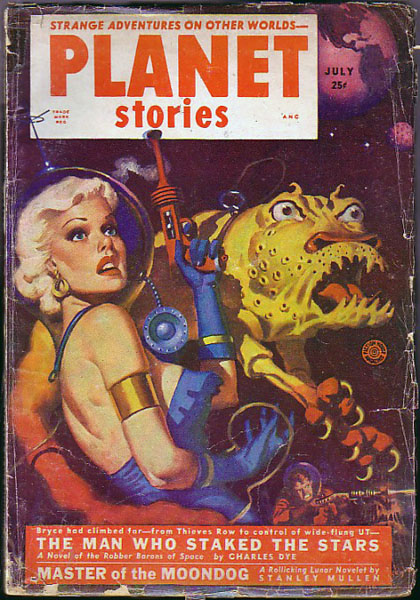
https://www.isfdb.org/wiki/images/b/bf/PLANETJUL1952.jpg

First appeared in Jack O'Sullivan's Planet Stories, reprinted by Robert Silverberg, Malcolm Edwards, Martin H. Greenberg, Damon Knight, Joseph D. Olander, Peter Davison, Susan Price, Stefan Dziemianowicz, Robert Weinberg, D. E. Wittkower, John Gregory Betancourt,  Ann VanderMeer, Jeff VanderMeer, Peter Ross.

A human crew collect their things readying to exit the planet. One has purchased a 400 lb. wub, a creature which  looks like a pig, presumably larger than a man at that mass. The natives respect the creature, but the humans--at least some of them--see it as a source of food. Even finding out the wub can read minds does not seem to deter the ship captain's appetite.

Analysis (with Spoilers)

The first reprinting of this story nearly two decades later was in Dick's own collection, The Preserving Machine. Perhaps an apt title. No one seems to have thought it demanded a second look when it first arrived. 

Robert Silverberg was the first editor to reprint it, twenty years later for his Alpha anthology, aimed at showcasing what SF he considered "literary"--a term which seems to mean different things to different people. Since Dick's story isn't necessarily highly evocative prose or rich characterizations, he must mean stories that provoke thought, which this certainly does do.

Dick's comment on "Roog" would probably apply here: "each creature view[s] the world differently from all other creatures." I will add more of his comment after I find my copy of Dick's collection.

What happens at the end of the penultimate section is vaguely worded and a little unclear. One possibility lies in the the wub's allusions to two major works of literature: the Bible (Jesus driving out demons that have possessed a herd of pigs) and the Odyssey (Circe transforming sailors into pigs)--the parentheticals are presumably the parts of the story Dick's is alluding to.

This possibility suggests that when the captain looks into the wub's eyes, he becomes the wub and vice versa. Or maybe, as the Vandermeers suggest, eating the wub makes one the "wub." This seems a strong possibility due to the allusions.

However, the other possibility is that the wub controls the captain as it did earlier, freezing the captain. So that the captain shoots himself. The wub assumes the role of captain and serves the former captain as dinner. This seems a good possibility because of the wub's early mind-control, the wub's discussion of sacrificing other members of the crew to eat, the vaguely worded "meat," and the reactions of the crew not wanting to eat the meat, due to cannibalism. Presumably if eating the meat made them "wub," at least a few others would have dug into the wub meat for supper becoming wub. But would they treat the pig as captain? Or is it controlling them to make them think of his as captain? The thing is that if the wub transfers from one creature to another, the alien probably wouldn't be a wub, but some other creature, originally, and there'd be no reason to "respect" the wub, necessarily.

The title seems to suggest that the wub is or will exist in the future or their future--physically or otherwise. Whatever's going on, the captain or the wub seems perfectly affable and chatty about the situation. In rereading, one wonders about what the native "respect" for the wub entails.

Tuesday, February 21, 2023

The Ship and its Cargo -- a different answer to the thought puzzle about identity

Someone proposed this thought puzzle (it is not Theseus' ship [Wiki] as will be explained after this puzzle): 

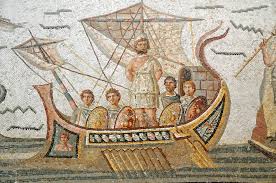
Odysseus sailed from Troy, and it took ten, long years. On the way, due to attacks of animals, sirens, insects, waves, storms, shipwrecks etc. the ship fell apart, piece by piece. As parts failed, they replaced them, one by one. When they arrived home, the ship had every piece replaced. Was the ship that left Troy the same as the one that arrived? 

[Assume this story of the ship is the more accurate one for the thought puzzle.]

It took me a day to think of a good answer for this, and it differs from other answers I've seen in the above Theseus puzzle.

The answer is yes and no.

First, each piece of wood is an individual with strengths and failings as it falls apart, the other parts of the ship have adjusted to this part's strengths and weaknesses, so that the ship's whole integrity is dependent on each part. So when a part fails and is replaced with a new part with strengths and weaknesses, the whole ship had adjusted to the old part and will treat the new part as if it were the old part. The new part has its own identity, but is also being called upon to play a new part. The ship adjusts to the new part's strengths and weaknesses.

This is not unlike a traffic slow down where the accident may be long gone, but the slow down remains. An echo of the old ship always remains. Yet, yes, there are new parts here, flowing through. 

A ship is not a ship without its contents, and in this case the crew create the ship's meaning, it's shipness. How the contents react to the ship--their habits of walking in the same places--creates unique wear, whether the parts are new or old.

If you transfer the contents to a new ship, built by the same people to same specifications, is that the same ship? No. Again, each block of wood employed is different. Also, to borrow from the cognitive-science explanation, the crew would not recognize it as the same.

This applies to humans, who are said to have replaced enough cells in seven years to be a completely new person. Are we still ourselves?

The ship metaphor translates well. Each cell replaced is an individual, yet is shaped by his neighbors. The other cells will be accustomed to certain ways of responding. So yes, sort of a new person?

But it will keep the same cargo, the same contents everywhere it goes--memories, desires, hopes. But these do shift. Is Odysseus the same Odysseus who left Troy? In a sense, yes. His dog recognizes him. He still wants to be with his wife. In a sense, no, his wife does not immediately recognize him. How could he have lived through all he's lived through be the same? But yet some of the same bilge and bilge rats linger.

#

Interesting thought experiment: If someone murders someone, are they still a murderer seven years later? I suspect most will have only one answer for that.

#

Despite a similar scenario--replacing parts until the new has all new parts--the Theseus ship is different. Quite different [Wiki]:

Theseus, the mythical Greek founder-king of Athens, rescued the children of Athens from King Minos after slaying the minotaur and then escaped onto a ship going to Delos. Each year, the Athenians commemorated this legend by taking the ship on a pilgrimage to Delos to honor Apollo. A question was raised by ancient philosophers: After several centuries of maintenance, if each individual part of the Ship of Theseus was replaced, one at a time, was it still the same ship? 

Here the answer is simply: No and Maybe, depending.

The difference here is the use. Odysseus was the one and only captain/owner. Theseus, meanwhile, has passed on, leaving the ship to descendants whose memory may or may not hold the original crew. A whole different metaphor is at play. The ship is now used for a wholly different purpose: commemoration. After the original passengers have all died and cannot pass on memories of this time, no crew remains to assign it the original meaning. 

It seems likely the scenario arose after a repair and someone, tired of the memorial, wants to know why they bothered remembering this ancient history and raised this thought problem in order to get out of having to repeat this stupid boat trip year every year.

This seems a very human reaction. In the Hebrew Bible--Exodus--the slaves who escape Egypt are supposed to commemorate this escape with a song, but soon they complain about how much better they had as slaves. Memory is short. Also, a very human reaction.

But someone somewhere has recorded the events, and if they did a good enough job, the ship can come close to having its original shipness.

#

Hobbes apparently proposed that if someone saved all the discarded parts, would that be the ship? 

Interesting thought experiment, but no. The parts are all rotted and broken although it would be a kind of cool memorial.


Saturday, February 18, 2023

"Frozen Journey" or "I Hope I Shall Arrive Soon" by Philip K. Dick

توییتر \ @RobinSandza در توییتر: «Very rare #illustration ...

First appeared in Playboy.  

Reprinted in various major retrospectives by Terry Carr, Brian Attebery, Ursula K. Le Guin, Chris Hables Gray, Alice K. Turner,  Jonathan Lethem. 

This won a Playboy award and was up for a Locus.

#

A man is cryogenically suspended for the duration of a journey across space. His chamber malfunctions so that he awakens ten years from his destination. He cannot be fully awakened or have his chamber repaired, so the ship computer dials up his memories for the man so he can dream pleasantly. But none of it goes as planned. 

Discussion (with spoilers):

The man keeps turning the memories into something darker, and as the ship's computer adjusts, trying to compensate, making the dreams lighter. The new, fake if dark memories bleed into every adjustment the computer makes. He can see through the illusions the computer makes.

When he arrives, his ex-wife summoned from another planet to help him adjust, he cannot accept the true reality.

Brilliant concept--at least not one I remember seeing before (although right after writing this, a newer TV show had a similar scenario, but not as thoughtfully executed. It doesn't feel like a classic but at least as profound as the great classics, so maybe it is classic? 

The story suggests that the past is preparation for whatever reality or future distorts how we view the present reality. Probably true--to an extent as we do test reality.

Terry Carr summarizes the above, more or less, and closes with "Could any computer, no matter how extensive its abilities, keep him sane?"

Is it about sanity? Maybe, kinda. But part of this summary is refuted by the story because the computer is not all powerful. In fact, it is relatively "dumb," limited in what it can do. It does see a problem, but not how to correct it. This, for me, is a critical part of the story, mentioned a few times. The computer doesn't intend to channel the person's reality--but simply to make him happier, which it fails to do.

This point in the story many not be wholly true as people (as opposed to the ship's computer) do actively try to channel people toward how they should view reality, but the basic concept is solid and thought-provoking. Perhaps it was somewhat less the case in the 70s and 80s that one might ignore the influence.

It's interesting that Dick's original title was rewritten by Playboy--probably more evocative or enticing to a reader. What's surprising is that Playboy's title is reprinted, not Dick's, despite Dick publishing his preferred title, even titled such as part of a collection. The Playboy title does suggest the man is stuck in his journey, frozen in time. 

"I Hope I Shall Arrive Soon" suggests more of the protagonist's state of mind, inviting the reader in to entertain the state, the feeling of making progress, of wanting to reach the destination but never arriving. It is more empathetic (his belief that he should be arriving soon even though he already has) and, hence, more tragic toward the character's failure to accept his reality. The "Frozen" unintentionally looks down on the character.

Ursula LeGuin's The Norton Book of Science Fiction has a nice tribute to Dick in the introduction, that he was finally getting his due. However, beyond adding the usual Dick-plays-with-reality, it offers no insight into this particular story, and it doesn't really add much insight into any particular story except in broad strokes. 

A famous, knowledgeable writer once said that the anthology chose the stories for a certain brand of politics. It may not have been, but let's entertain the notion. This will take a while since it's not high priority, but I'll touch on it.

The anthology arranges stories by year, presumably to show either progression in sensibility, changes in topical concerns, quality, etc. But presumably those were the best stories from that year. Only Carr selected this story as one the best of the year. It's numbered eight on Locus (with no other award nominations), so maybe the listing by year (in terms of quality) is misleading. However, an editor may think stories were overlooked in a given year, so that may be a factor. It could be the issues facing the public during that year. Was 1980 a year of being frozen in place, compared to any other year? But if so, why doesn't the anthology discuss issues facing the field during that time?

Finally, this could be the story most representative of the writer from 1960-1990, but then the listing as stories by year would be misleading. Moreover, a lot of important writers were excluded from this collection, which would be a major flaw for an anthology with this particular title, which sounds like it has a wide-enough-angled lens to capture the full scope. The anthology was never revised, so maybe the flaws are well known as being too limited in scope to bear its current title, lacking a number of key players who helped shape the field during this era.

The anthology does use the Playboy title over Dick's. If it were a political selection, it was the positive portrayal of the ex-wife. She was empathetically drawn. Hopefully, it is not for the wise woman/foolish man (or worse men-bad/women-good) portrayals, which would be sexist if this is a consistent pattern--limiting both genders to certain roles that can be played. Hard to say from this distance. Perhaps the editors felt they needed to counteract other portrayals, but still it's problematic if it's men-good/women-bad. Humanity has lots genes, lots of differences to limit the species to a handful of portrayals. 

Feminism becomes important to the field, especially during this era, so one would expect it to be addressed, but it is certainly not the only issue, and the anthology would require a different label to be more honest to the public about the anthology's aim. But that's only the case if it were true that LeGuin's anthology is political--a hypothetical claim being entertained at present. And we'll come back to it later, fingers crossed.

Still, the story's a lovely little gem, whatever reason people selected it.  Maybe some will read it as a tale about sanity, or about gender-power dynamics, tripping some triggers. That's okay. For me, it's a potent tale with a broader application for all humanity--not a select few--about a human being whose propensity to find flaws in his own life led him to a place that made it difficult to deal with his present circumstances. Surely, that is a theme that people of whatever gender can empathize with.

Wednesday, February 15, 2023

"Roog" by Philip K. Dick

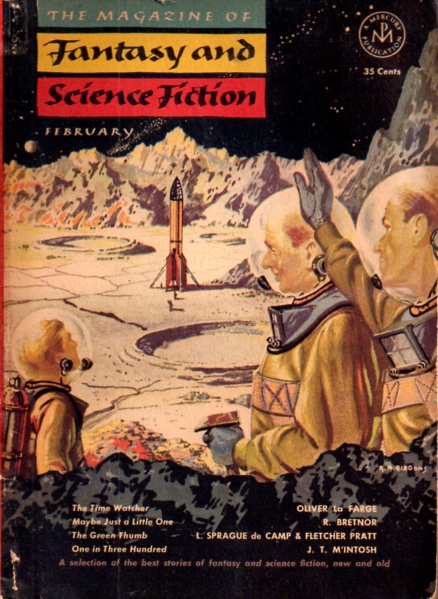
https://www.isfdb.org/wiki/images/2/26/FSFFeb1953.jpg

First appeared in F&SF. Reprinted by Anthony Boucher, J. Francis McComas,  Robert Silverberg, John M. Landsberg, Jonathan Ostrowsky-Lantz, Jack Dann, Gardner Dozois, Stefan Dziemianowicz, Martin H. Greenberg, Robert Weinberg.

This was Philip K. Dick's first accepted story, but not his first published. It tells of a dog who can see aliens as garbage men.

Discussion (with minor spoilers):

While not a classic, this is utterly charming. Part of it is the perfect name for the alien which sounds a bit like how a dog might sound, barking.

What's fascinating is a debate with the famed editor Judith Merrill over the story (a debate which you cam read about over here). She thought that the description of the aliens did not match the garbage-men she'd seen. This is the kind of debate that sidetracks a lot of literal-minded fans and editors and critics. Myself included. 

Even Dick is mostly persuaded by Merrill's argument that he have lost sight of his own story. He calls it a fantasy through the dog's point of view. It could be. A realistic tale of a dog who thinks garbage men are aliens. But there are other possibilities--more interesting ones.

That's the key: Whose POV is it? It's probably not the dog's. Maybe, but probably not. Was the dog there to witness all events? Maybe? Certainly not the humans--at least not these humans since they don't seem to know what's going on (perhaps humans in a post-human-Earth era?). Maybe the aliens, but they don't seem to be there to witness everything as well.

Perhaps it is simply an omniscient narrator. The aliens, if real, admit what they're doing. They're making the dogs or Guardians seem like deluded creatures. Maybe they are. 

Or maybe the aliens are deluded into thinking the dog see them. Maybe the dogs don't see the aliens as aliens at all.

But again maybe the dogs do. Maybe they are masked and dogs can see through the disguise.

What the aliens are up to, isn't clear. Are they just after trash? Why is it an "offering urn" and why do they eat it? Do they consider themselves gods? Or do they offer it to other gods, carrying it in a blanket? Whatever is going on, it sounds sinister. And once they clear out the dogs, they will be able to execute that plan.