Search This Blog

Thursday, March 21, 2019

The Challenge: Henry Miller's Quiet Days in Clichy

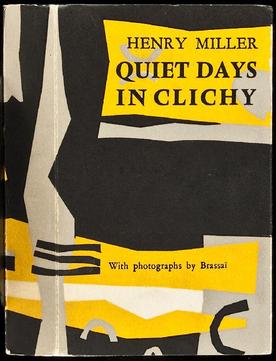
MQuiet Days In Clichy First Edition.jpg
I used to pride myself in being able to read anything, but then I read what they call "torture porn" (not that it's porn, but that it details and seemingly revels in a non-stop torture) or the story that merely tries to be offensive. One asks, "What is the merit?" One could say it's exercising free speech. So be it.

I ran up against this in this short novel, Quiet Days in Clichy, a misnomer, which apparently Miller knew when he chose it. I picked the novel up because it was short, and I was grooving on Miller's observations of people and certain stylistic passages that passed muster for poetry. But here, I had to ask myself why I was reading this.

Where some of his narratives fail to cohere, here it was a more traditional cause-and-effect although it was told out of order for no reason I could fathom. Apparently this has been filmed twice, in 1970 and 1990 (IMDb: 5.4 and 4.9, respectively). The second half of the book (minus Colette) was also filmed and fared slightly better at 5.7. I'd probably pass on them. I'll include trailers here for the curious, but fair warning: the 1970 version displays in abundance a word many find distasteful. The second one is also NSFW.

The narrative might go something like this: Two impoverished writers look for money, food, and sex with prostitutes. Along the way, Carl picks up an underage girl whom they call Colette and who then lives with them. The narrator finds little merit in the women they pick up, or if he does, it's an almost strange ineffable-ness.

What is interesting is actually left outside the narrative: The underage girl is described as a doll, maybe dull, dim-witted. However, I kept wanting to look around the limits of the narrator to see who she really was.


From what little we get of her, she seems dreamy, lost in reverie. She'd disappear. Sometimes for days. Obviously free to do as she pleased, she comes back. One day the men follow her, and she meanders on long walks, contemplative. She sticks with the men. Whatever they have is apparently superior to whatever her presumably rich mother and step-dad have. What is that?

There's something sad in that: to prefer the company of two destitute men, perhaps to carve out one's independence and domestic bliss with men who probably had less interest in her domesticity although apparently they enjoyed it to some extent. Interestingly, the parents know Carl has committed a crime but don't prosecute. Why? What would prosecution bring to light that they don't want raised? Or are they of a more morally relaxed bent? What drove Colette out and that she was willing to return to (not that she may not leave again) or had she been caught on her wanderings? I can't help picturing her mind on those walks dreaming about a better life, or maybe she thought that this would become a better life, eventually

My challenge for another writer, as I think it'd need a female hand, is to write the story from the underage girl's point of view. How does she see this arrangement? At first it seems more desirable yet it becomes less so--living with two intelligent men who are actually shallower than they think--at least with the women they bring into their lives. I suspect, if the writer were able to maintain some objectivity with a focus on aesthetics, this would be a more literary approach than what's here presently.

This raises the question of what makes good art. What is obscenity or porn without merit, and what is "literature with erotic motifs?" I just discovered that phrase in comparing this to Vladimir Nabokov's Lolita since both involve similar subject matter. That phrase belongs to Nabokov in this case as it hints rather than displays. However, Miller goes beyond that.

Back in the 20s and 30s there seem to have been a number of novelists like D. H. Lawrence, James Joyce and Henry Miller who were challenging what could be included as literature. For some reason in the 50s and 60s, we as a society loosened up our morals and opened the gates to sexual situations in literature, citing the First Amendment for free speech.

As a person with biological and literature training, I find this natural. How does this impact character relationships? For me, this is the dividing demarcation between art designed to make us think and work that is designed to stimulate and be sold.

I read five pages or so of porn novel in Junior High. We were in a hotel lobby and a fellow swimmer had ducked into a hall and discovered a vending machine with porn novels in it. He bought one and ended up with two copies. This stirred conversation in the room as the books circulated, and of course, I had to read it. It was non-stop "action" thriller, which meant the author had to come up with some bizarre stuff to maintain the reader interest. Obviously, since I read only five pages, the stuff was a little too bizarre.

If that is a marker of porn, then Quiet Days isn't porn, but it is one step below. Because it's Miller, I want to dub it literary erotica, but I don't know that it merits "literary" if I were to follow my own definition above.  It fails to focus on language. There is some interesting observation of characters, but rather like a weak tea. This landmark case of  Miller vs. California [different Miller] redefined what obscenity was. A number of famous novels have apparently been deemed as obscene in the past, some of which might surprise you.

The new way to configure obscenity were three ideas:
  1. whether the average person, applying contemporary "community standards", would find that the work, taken as a whole, appeals to the prurient interest;
  2. whether the work depicts or describes, in an offensive way, sexual conduct or excretory functions, as specifically defined by applicable state law (the syllabus of the case mentions only sexual conduct, but excretory functions are explicitly mentioned on page 25 of the majority opinion); and
  3. whether the work, taken as a whole, lacks serious literary, artistic, political, or scientific value.
Does this novel pass muster? I'll leave that to you to decide. If you've read it, what did you think?

I discuss two other Henry Miller novels:
  1. Tropic of Cancer and
  2. Black Spring.

Tuesday, March 19, 2019

Banned Books: Black Spring by Henry Miller

Image result for Black Spring by Henry MillerI wanted a comparison of Tropic of Cancer (previous commentary) to Black Spring. Is one better than the other? They're both written by the same guy with a similar stylistic verve, yet one can see why one book might be preferred. Tropic of Cancer has a more personal feel, but it is also grimier. Black Spring has subject headings. I read someone call them stories, but I'm not sure they're that. If you take “The dreamers dream" quote below, it is a complete paragraph. It could stand alone, or be lumped with another "story" entirely. I suspect that one inspired another, yet I also suspect a completely new book could have been achieved by reshuffling. Perhaps Tropic of Cancer could have used an organizing principle, even if the organization were arbitrary. I'm sure academics have staked their careers on the organization.

It seems to me my initial impression was correct, in terms of savoring a passage and setting the book down. A movie will never be made out of his books*--or  at least not a faithful one based on the events since what are the events? Moreover, this book quotes and structurally a kind of Lewis Carroll's Alice-in-Wonderland surrealist logic. There is a dialogue but it doesn't feel like a real one (see the last quote). No, Miller may best read as a prose poet, as a writer of passages, as etcher of lyric essays. The books may cohere as a poet's as well. Note that Lawrence Ferlinghetti quotes Miller for the famed title of his collection, A Coney Island of the Mind.

Opening a Miller book is like opening a box packed with poets' toys. Karl Shapiro called Miller's work wisdom literature, and in some cases as in some of the quotes below, I believe he's correct.

Cool Quotes:
"I do not have to look in my vest pocket for my soul; it is there all the time bumping against my ribs, swelling, inflated with song."


“The dreamers dream from the neck up, their bodies securely strapped to the electric chair. To imagine a new world is to live it daily, each thought, each glance, each step, each gesture killing and recreating, death always a step in advance. To spit on the past is not enough. To proclaim the future is not enough. One must act as if the past were dead and the future unrealizable. One must act as if the next step were the last, which it is. Each step forward is the last, and with it a world dies, one’s self included. We are here of the earth never to end, the past never ceasing, the future never beginning, the present never ending. The never-never world which we hold in our hands and see and yet is not ourselves. We are that which is never concluded, never shaped to be recognized, all there is and yet not the whole, the parts so much greater than the whole that only God the mathematician can figure it out.”


"She's got millions of them inside her and they're all whirring around in there dying to get out. Whirrrr ... whirrrr. And if you'd just put a needle inside and puncture the bag they'd all come whirring out... imagine it... a great cloud of soul-worms... millions of them... and so thick the swarm we wouldn't be able to see each other.... A fact! No need to write about China. Write about that! About what's inside you..."

* Bold proclamation that has already turned out to be untrue after a few minutes. He's had four or five, but none of them are especially well received. This one for Tropic of Cancer got a 71 tomatoes from critics, 25 from the lay audience, and a 5.7 from IMDb, which rounds out to a so-so movie. The others, linked to here when the post is finished, fared slightly worse, but still within the so-so range. I do think Black Spring would be particularly difficult to film, so I won't edit out the statement. I don't see how a movie can capture Miller's strengths as a writer.

I discuss two other Henry Miller novels:
  1. Tropic of Cancer and
  2. Quiet Days in Clichy (his most filmed).

Sunday, March 17, 2019

Poetry in the News

W. S. Merwin passed away. His poem "Language", with its Biblical overtones, could be read as his own eulogy/elegy:
"Certain words now in our knowledge we will not use again, and we will never forget them.... they are, trembling already for the day of witness. They will be buried with us, and rise with the rest."
A number of people are using his poem, "For the Anniversary of My Death," which sounds like someone will speak to us wisdom from the grave, but it's a little tricky like Robert Frost's "The Road Not Taken." It's actually a living man who speaks:
 "Every year without knowing it I have passed the day"
"I have passed" indicates he's alive (also it's a clue, too, that the poet was alive when writing the poem). The phrase "without knowing" is key. The lack of knowledge but the presence and possibility of death seem to hang over him. It is both definite and mysterious. He later alludes to life as a "strange garment."

The next five lines discuss death, but the last seven address his life right now--not just the love of a woman, or the problems of the world--but this very moment, staring into nature, observing its beauties. The final line is almost Biblical, a warning about what one serves in life, knowingly or unknowingly.


#

Poetry reading is up, according to this USA Today article. (The title claims fiction reading is down, but later quotes that the fall is statistically insignificant.

#

In a similar vein--at least, the logical next step--here's an answer to the question about poetry careers which, given that it is a poem, is no answer at all:

When we were younger, guidance counselors steered us
toward respectable occupations: doctor, lawyer,
pharmacist, dentist. Not once did they say exorcist,
snake milker or racecar helmet tester....
#

I'm not sure to what extent Theodore Sturgeon could be a called a poet, but he does use poetic techniques, and this interviewer had that in mind.

Friday, March 15, 2019

Banned Books: Henry Miller's Tropic of Cancer

Image result for The Henry Miller Reader
This post is rated PG, but it discusses and links to R-rated material or higher. There's a reason this is listed among the most banned books.

#

When I first read Henry Miller in college, I had no idea he'd been banned in the US and Great Britain. I picked up a volume called The Henry Miller Reader--a volume compiled to get around the ban by leaving out all of the salacious bits, which is the volume I would recommend to those who want to get a taste for his work but don't want their sensibilities offended--and was smitten by the prose. I read what amounted to a feast of food and words and swooned. I read and reread the passage, seeing what he'd done. I bought a metric ton of his books based on that five-page work alone.


#


But I never returned--at least not systematically. Instead, I read him haphazardly. I'd pore over a passage, fall in love, and close the book, feeling no compulsion to read anymore. I thought it a flaw, at the time. South Park creators, Matt Stone and Trey Parker, call this "And, then" writing (see video clip on right), which they consider bad--at least from the standpoint of getting most people to follow your art.

#

I was inspired to revisit Miller thanks to the Bradfield video here (he discusses a book I suspect was never banned and might be a safer exposure to Miller). Bradfield recommends Tropic of Capricorn and Big Sur over Tropic of Cancer. However, others have recommended it over other books--for example, the Modern Library lists as one of the top one hundred books of the 20th century, so why not?


#

The way to view Miller's work is through the lens of a lyric poem. In a narrative poem, we expect to be centered in the world. In Miller's work, we are centered in the mind of the narrator or persona who may or may not give you a map, who may or may not lay out entrances and exits, who may or may not (well probably not) give you transitions in place and time. All he lends the reader is his consciousness and unique voice.

#

I thought I'd hit upon an original perspective of Miller but no, at least not completely. Karl Shapiro suggested this in part in his introduction to Tropic of Cancer:

"I do not call him a poet because he has never written a poem; he even dislikes poetry, I think. But everything he has written is a poem in the best as well as in the broadest sense of the word."
Side note: I am curious if Miller's autobiographical fiction influenced the confessional mode of poetry. Clearly poets like Shapiro were reading him in the 50s before the ban was lifted.

#

There will be those who struggle with Miller's work, not just sexual prudes or narrative prudes, but also moral prudes. He will push all the buttons. He will test readers whether they read for aesthetic purposes or political ones. It's a kind of litmus test. If you don't pass, well, try out his Reader mentioned above. If this had been twenty years ago, I would have been surprised at even the necessity of discussing the distinction between art and morality.


#

I don't find his work as sexy although it is full of sexual situations, rather grimy ones--sometimes repulsive. You can try out the Miller Tropic of Cancer excerpts here. The first one links to the first forty pages. The second is an edited excerpt about Germaine--more of a character portrait than a story. It appears about a page and half after the first excerpt. This one cuts out Claude from the original text, which is a comparison of whores. I felt no arousal but found the description a fascinating perspective.

#


How can I recommend a writer without sharing his values or suggesting that others have to agree with him? How can one be a good reader and not read about people different from him? Sure, we are free to condemn, but that lies outside the scope of aesthetics and art--two separate issues.

The difference might be likened to watching a nude master swimmer in a public pool. You can comment on his skill on the one hand, and talk about the indecency on the other. Sure, you can focus on only the indecency, but you've missed out on much of the experience.

Do you have to read Miller? Should Miller be forced on others? No and no, respectively, but he is worth experiencing. What I notice in complaints is that a sample represents the whole, missing out on the bigger picture. One could say that he missed the boat on some aspects of human experience, but that is the human experience in literature: It is largely filtered by a human being who may be flawed.

#

That said, there are vulgarities that repel me from reading--offensiveness for the sake of being offensive which is not an aesthetic perspective. Maybe if Miller had spent too much time on vulgarity I would not be able to read him [ETA: I just read Quiet Days in Clichy, which did test my resolve. Link will function as soon as I finish writing about it]. It is not even just a matter of quantity but of quality. Miller is an observer, a student of himself, others, and humanity, which is part of what imbues his work with charm. He's a hungry artist, wandering the streets, apartments and brothels of Paris. He is perpetually looking for food and money, perpetually short of both. He is perpetually hungry for words and sex and finding a vitality in both. He is living in Paris after most of the famous literary artists had been there, following footsteps but making his own imprint. He is living in Paris during the Depression and the coming Second World War. His appetites are phenomenal to caress both aurally and on the page.

Since much of the work is within the narrator's consciousness and lacks the kind narrative thread one can follow, I'm not sure if an audio book is the best way to experience Miller, but then his words are also an aural feast, so I'm not sure if even that assessment is correct. There may be multiple paths into Miller's work.

Here's an excerpt that captures much of the elegance and energy and perspective that Miller offers:

As luck would have it I find a ticket in the lavabo for a concert. Light as a feather now I go there to the Salle Gaveau. The usher looks ravaged because I overlook giving him his little tip. Every time he passes me he looks at me inquiringly, as if perhaps I will suddenly remember. 
It’s so long since I’ve sat in the company of well-dressed people that I feel a bit panic-stricken. I can still smell the formaldehyde. Perhaps Serge makes deliveries here too. But nobody is scratching himself, thank God. A faint odor of perfume . . . very faint. Even before the music begins there is that bored look on people’s faces. A polite form of self-imposed torture, the concert. For a moment, when the conductor raps with his little wand, there is a tense spasm of concentration followed almost immediately by a general slump, a quiet vegetable sort of repose induced by the steady, uninterrupted drizzle from the orchestra. My mind is curiously alert; it’s as though my skull had a thousand mirrors inside it. My nerves are taut, vibrant! the notes are like glass balls dancing on a million jets of water. I’ve never been to a concert before on such an empty belly. Nothing escapes me, not even the tiniest pin falling. It’s as though I had no clothes on and every pore of my body was a window and all the windows open and the light flooding my gizzards. I can feel the light curving under the vault of my ribs and my ribs hang there over a hollow nave trembling with reverberations. How long this lasts I have no idea; I have lost all sense of time and place.

I discuss (or will discuss shortly) two other Henry Miller novels:
  1. Quiet Days in Clichy  (his most filmed) and
  2. Black Spring.

Wednesday, March 13, 2019

The Grammar Wars Wage on

"When it comes to writing fiction, you don't owe your English teachers or grammar Nazis anything. If you need to crack the rules to keep the rhythm or poetry of a sentence, do it. As long as a reasonably intelligent reader can parse the sentence that's all that matters."
--Richard Kadrey on grammar

Grammar "nazis" have been touting this legal proceeding (this blogger claims that the "Grammar debate [is] Settled" in bold meme-like fashion) as proving that the Oxford comma is the only way to go. Not using the Oxford comma might lead to mistaking it for other uses of the comma. Here is the example Grammarly provides:
"I love my parents, Lady Gaga and Humpty Dumpty."
One writer may be trying to say he (or his character) loves those three people/groups. However, another writer might have been using the comma to define who his parents were: Lady Gaga and Humpty Dumpty. A reader could become confused. Some use this example to command the necessity and inflexibility of the Oxford comma rule.

[Sidebar: In the above law case, I don't see a second reading of the sentence that would make the legal sentence understood in more than one way. It claims a list of exemptions to follow, so why would a writer list a non-exemption? Nonetheless, pay the time and a half overtime unless they're salaried upper class. Overworking someone means workers have to spend more time recovering. If you don't understand this, you may be a robot which should distribute its wealth to working human beings.]

As Grammarly points out, their sentence could be rewritten with the comma after "Gaga":
"I love my parents, Lady Gaga and Humpty Dumpty."
Conversely, one could still omit the comma and rewrite it:
"I love Lady Gaga, Humpty Dumpty and my parents." 
Now there is no confusion. No one (no one reasonable) will think he is trying to define Lady Gaga as an amalgam of Humpty Dumpty and his parents. But you never know.

Some writers might want you to conflate both notions at the same time:
"My greatest influences are my parents, Lady Gaga and Humpty Dumpty."
Here a writer might want you to experience both sentences simultaneously and to explore those implications. However, the rest of the work--that is, the context--should suggest this as well.

Note in the above Kadrey quote, he omits a comma in the last sentence, separating the dependent clause from the independent clause. Now, were I proofreading, I'd probably place it there in case he missed it. In some sentences it might confuse readers. Here it does not. I missed it on the first read.

Some writers remove commas (or pauses) for a reason--probably to speed up the passage, even if technically there should be one there. Whether you can get away with it probably depends on 1) if the sentence can makes sense without it, 2) how famous you are, and/or 3) how much of a grammar nazi your editor is.

Monday, March 11, 2019

Review of Agatha Christie's The ABC Murders (2019, Amazon Prime)

Amazon Prime did it's own version of Agatha Christie's The ABC Murders [link to movie], which is one of her more striking and elaborate mysteries. Thanks to the BBC, viewers have a certain expectations. While one expects murder, gore and the unpleasantries of life are minimized. What is maximized is the puzzle of the murder. This type--the "cozy"--has been so well defined that even Merriam-Webster has an entry for it:
"a light detective story that usually features a well-educated protagonist and little explicit violence"
Image result for Ian McKellen's Mr. HolmesThis definition already contains its critics' own condemnation as "light." A true aficionado would probably bristle at that and suggest that the puzzle is foregrounded, which can be an intellectual if a reader so chooses to match wits with the detective, so that it is not necessarily light. The "light" probably refer to its shrugging off of violence (hence, realism, in some minds) or perhaps of literary pretensions.


It's little wonder that viewers would bristle at an Agatha Christie mystery where violence in presented (if not gruesomely so) as well as the seamier side of life (if not salaciously so). Any fan upon first viewing this three-part series may balk, wondering if the additions are gratuitous moderizations of Christie's work. But if you liked Sherlock Holmes' updated, more personal treatment from Ian McKellen's portrayal in Mr. Holmes, you might well be intrigued by John Malkovich's portrayal of an older Hercule Poirot. They aren't mirror images. This one has a murder mystery at its heart whereas Mr. Holmes has a personal mystery.

Hercule Poirot has no sidekick (no Captain Arthur J. M. Hastings, OBE to bounce ideas off of), which makes sadder and lonelier. Worse, he's lost his ally in the police with only a detective (played surprisingly well by Rupert Grint) who isn't interested or doesn't trust Poirot. Poirot has been receiving taunting letters from "A.B.C." who eventually resorts to murder. The murderer seems to have a personal vendetta against Poirot, forcing him to rake through his brains for someone in his past. Since the police won't help, Poirot has to take on the murderer alone.

Poirot's own past and his ability to detect are called into question and have a bearing on the case. The mystery is not quite well delineated as a puzzle to match wits with the private detective as in most of Christie's work, yet I do believe well worth watching, even if (especially if?) you've seen it before.


Saturday, March 9, 2019

Two videos dealing with the aftermath of WWI

This video about Anna Coleman Watts Ladd, a sculptor (wiki link includes more personal info) who made masks for facially disfigured survivors of WWI in France. Warning: Slightly grotesque, and her miracle work might make you weepy.

#

The second video, below, treats how soldiers with PTSD (or shell shock) were treated in that era by different countries.