Search This Blog

Friday, June 6, 2025

"A Defense of Social Contracts" by Martha Soukup

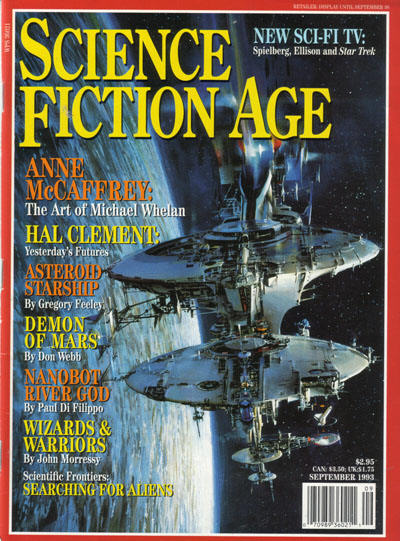
First appeared in Scott Edelman's Science Fiction Age. Reprinted by Pamela Sargent. Won the Nebula, up for the Tiptree awards.


Summary:

In a world that has idealized and perfected social contracts and licenses for every potential kind of love, with some crossover, Derren and Anli meet and begin a relationship with very different expectations--despite the supposed clarity of their situation.


Discussion with Spoilers: 

Anli knows Derren is nonmongomist, but that doesn't deter Anli from trying to maneuver him into a committed relationship--so much so, the story ends in tragedy, in as much as a perfect society could have a tragedy.

The best story to contrast this with would be Frederik Pohl's "Day Million." Both spend most of their time telling the story more than the standard story. 

The second and perhaps primary thing to pay attention to is the narrator's voice--both of which look down their noses at those who might disagree (although Soukup's narrator assume you'd agree). Though we feel for the situation Anli put Derren into, a number will also feel for Anli. While some readers may have zero sympathy for Anli, more than a handful may feel for her attempts to get Derren into an exclusive relationship. Unlike Pohl, everyone on the planet knows someone (or is someone or has received overtures from someone) who tried to force another into a relationship the other party didn't want.

That it won a Nebula people can debate, but it is a worthy candidate. Is it a classic? Again, one might debate its merits, but if Pohl's is a classic, then surely this is, too, being more complex. 


Wednesday, June 4, 2025

"Over the Long Haul" by Martha Soukup

https://isfdb.org/wiki/images/f/f0/AMAZMAR1990.jpg

 First appeared in Patrick Lucien Price's Amazing Stories. Reprinted by James Morrow. Up for the Hugo, Nebula, and Homer awards.

 This was adapted for an anthology show called Perverse Destiny, directed by Danny Glover, starring Erika Alexander and Lou Diamond Phillips [IMDB].


Summary:

Shawna Mooney is a single mom and a truck driver. Both. At the same time. It's not exactly a requirement, but in this future, it's become that way where people have to work. The trucks are mostly self-driven. But Shawna has seemed to have found love in the most unlikely of places: on the road, at rest stops as moves along her route. The gentleman is also a driver who only seems to have eyes for her.


Discussion with Spoilers:

After talking and making out with her at two stops, the gentleman seems to think they'd make a good couple and says he wants to introduce one of her children to his to see if they can get along in his truck. The only problem would be at mandatory child-check, but he knows where this will be and understands how the trucks talk and announce themselves. She consents as he is so knowledgeable.

However, a mandatory stop rears up before she knows it, and she does not have one of her two children and will get in trouble for that. She blows past the stop to catch up with the bad guy who is shipping contraband and needed a child to get through these stops.

The 80s and 90s seemed to be an era for wanting to inject the domestic into SF, more so than others, but this is quite astonishing mixing the future with trucks and child-rearing. This is Soukup's first story to grab the attention of award peoples, which isn't too surprising although my attention wandered in the middle. But the narrative takes off towards the end.

The premise is interesting and perhaps prescient considering how it anticipates our present--if not also problematic. Even if she doesn't need to give the truck her full attention, presumably she needs to take over, but it seems quite likely that a child might need attention when the road requires it as well. 

Much as I didn't want the protagonist to get in trouble, no doubt she would have gotten in trouble for giving away her child, potentially losing both children and her job.

Sunday, June 1, 2025

"Displaced Person" by Eric Frank Russell

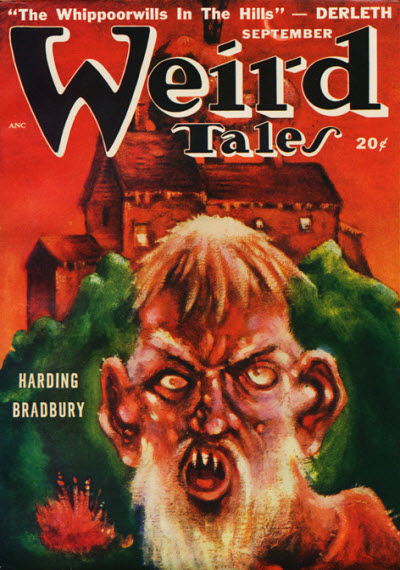
 First appeared in D. McIlwraith's Weird Tales. Reprinted by Terry Carr, Peter Haining, Isaac Asimov, Martin Harry Greenberg, Joseph D. Olander, Al Sarrantonio.


Summary: 

 A man arrives in a foreign country although who he is and why is part of the mystery.


Discussion with Spoilers Galore: 

While not the most stylistically impressive, there are four mysteries to unravel. A person cannot read it too quickly. If you get only one, you'll probably hate it. Two, it's okay. Three, you like it. Four, you might consider it a minor work of genius as Terry Carr apparently did by collecting it into a major fantasy anthology. 

First is the displaced person and out feelings toward them. Most of humanity is bound to feel empathy toward this person. In fact, on the same year this story was published, the President signed the Displaced Person Act. However, this person admits to being the cause of the war. Does that erode the natural empathy a person might feel?

Second, the easiest, is that the displaced is Lucifer, but hold on to this or you'll dismiss prematurely. It refers to the war in Heaven in John Milton's Paradise Lost--a character most professors love and love to love to antagonize people of faith because his character is considered the better vs. God.

Third, remember when this written, the war that had just taken place. Who might Lucifer apply to?

Fourth, now that you have all the relevant information, which you can only get once you know who the player is, you'll need to reread. And on that reread, you'll note the careful balancing that Russell has put into play. The four surprises combine and it puts one in a weird place (hence, weird tale). It becomes a mirror for anyone's too quick response.

That Terry Carr was the first to reprint it a quarter of a century later suggests that few read the tale with the time and attention it deserves.


Sunday, March 16, 2025

"Masks" by Taylor Grant

A Feast of Frights from The Horror Zine ...

First appeared in Jeani Rector's The Horror Zine. Reprinted by Jeani Rector, Adam Millard, Zoe-Ray Millard.

Summary: 

A man finds himself changing... for the worse. Becoming a little more aggressive as each day goes by. He even finds himself grinning about what he's done in a creepy way while at the same time feeling shame.

Discussion:

I feel like I should have seen where this was going but did not. What motivates our worst behavior? 

There's no mastery of style but the story itself is superb. It'd make a great addition to a TV horror anthology episode.

This appears to be the author's most reprinted tale. It opened his first collection of stories, which was nominated for a Stoker including a story that was also nominated.

After a 2-&-1/2-year battle with cancer, Taylor Grant died about six months ago, reported on his Go Fund Me page (see last few updates). I became interested in his work after reading his posts on Facebook--often witty but at times deeply spiritual as he faced the end. The entries were so personal and heartfelt, it was as if I knew him and his passing a blow to the chest.

The battle drained his coffers and people have generously donated now for his son's education. 

He has a handful of stories not collected in a collection--not to mention an interview and essay. They don't add up to a complete collection (there may be others lurking in uncommon venues), but a collected works might be worth doing. 

Saturday, February 22, 2025

Vital Signs by Deborah P Kolodji

Vital Signs: Kolodji, Deborah P: 9781735025780: Amazon.com: Books

Vital Signs appears to be Kolodji's final book--at least while she was alive. It chronicles her journey through cancer via a series of haiku. The first haiku opens:

the blush of dawn 

through a hospital window

vital signs

The hope and fear infuse the poems as the speaker crawls through visits to the hospital, trying to claw back her life. 

The California condor, pictured on the cover, is for her a personal image of a vital sign. It has survived near extinction and bounced back.

sturgeon moon

my pillowcase covered

with fallen hair

Not much is gained by explaining the sturgeon moon, but it is "[t]he [f]ull [m]oon in August... because of the large number of sturgeon fish that were found in the Great Lakes in North America this time of year." [Timeanddate.com]

his old toolbox

no way to fix

all that's broken

Be ready to have your heart broken.

Kolodji's work has won the Dwarf Star and the Touchstone. Her chapbook, Tug of a Black Hole, was runner-up for the Elgin. Born on August 11, 1959, she passed on July 21, 2024. She has left behind several potent poems. A book of selected verse would worth pursuing.


Wednesday, February 19, 2025

"Comes Now the Power" by Roger Zelazny

 https://www.isfdb.org/wiki/images/3/34/MGZNHRRWINTER1966.jpg

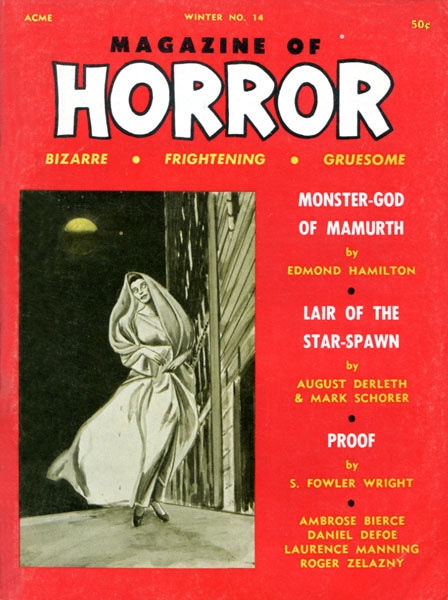
First appeared in Robert A. W. Lowndes's Magazine of Horror, finalist for the Hugo, reprinted by Lee Harding, Matthew Berger, Alexander Klapwald, Kenneth Sharp, Brian Attebery, Ursula K. Le Guin, Tracy Hickman, Margaret Weis.


Summary:

A man, who used to have telepathy, has forgotten how to do it. He finds a female mind who is able to do it, so he seeks her.


Discussion (Spoilers):

After a few failed connections, the man connects and she helps him breakthrough whatever was blocking him. However, he learns she is a young woman, hopitalized and dying, so his connection brought her memories of his life, so before her death, he gives her all that he has.

This is a wonderful, efficient little tale. I'm conflicted. It does a beautiful job executing the story in an emotionally impactful way. Any complaint would be negligible. However, is it one of the great tales? Does it resonate past its confines? Emotionally, yes. Is it a classic that makes you ponder the outcome in some meaningful way? I'm not sure that it does except to a minor degree. However, its inclusion--and a number of these brief, impactful tales--is a kind of challenge. What kind of story does belong? Does it need to be of a certain length? Fredric Brown's "The Weapon" is just a few pages long, but it wouldn't surprise me to be in such a major anthology like Norton's considering the way it forwards an integral question, better than stories 10x its length. What makes a major work? Something to ponder. 

Also interesting that this originally appeared in a horror magazine but there's really nothing of horror in it. Perhaps the major magazines passed on it--which boggles the mind--and Lowndes took it despite the lack of horror. 

(It appears that the title changed over the years and at one time had "and strange stories" which would makes more sense. Perhaps it was trying to hop on the horror train and dropped the original title.)


Friday, February 14, 2025

"The House the Blakeneys Built" by Avram Davidson

https://www.isfdb.org/wiki/images/8/87/FSFJAN65.jpg

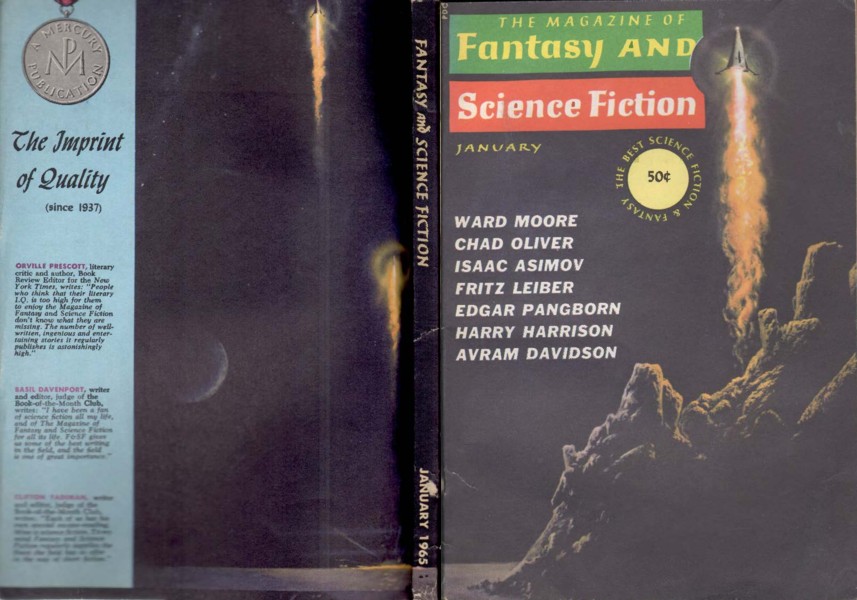
First appeared in Joseph W. Ferman's The Magazine of Fantasy and Science Fiction. Up for the Nebula award, it was reprinted by Edward L. Ferman, Martin Harry Greenberg, Carol Mason, Patricia Warrick, Brian Attebery, Ursula K. Le Guin.


Summary:

 Two couples of colonists (one pregnant) arrive on a planet and find a road that leads to a castle [they seem uncertain if that's the correct term]. They want to build a house beside the Blakeneys's, a very strange extended family--presumed to be inbred after living alone together for so long--speaking a pidgin language. The Blakeneys came here to escape persecution.

When the foreigners arrive, they are welcomed. But then the new colonists go to build their own house. The Blakeneys seem less responsive, the new colonists borrow a few necessities and promise to repay. The foreigners plan to have their kids intermarry to avoid the Blakeneys for a time, but eventually they'd have to marry to improve genetic rigor.


Discussion (with Spoilers):

We are meant to think of the nursery rhyme "This Is the House That Jack Built," which is a cumulative tale. This sort of song opens simply, gradually accruings wilder and wilder causalities until it becomes the Butterfly Effect, where a flap of a butterfly's wings causes a typhoon halfway around the world.

The parallel here is similar in that what we are initially given is a simple family who seem to welcome new colonists when they are a part of the family or home. But as soon as they have a house apart from theirs, they attack. The chain of causality is not immediately apparent, but there seems to be a critical system of governance that has been violated making the new colonists worthy of death. With some irony (or maybe none, that is, it is part of the causality), the Blakeneys now persecute where before they were persecuted. Or were they? Was it their behavior that caused people to persecute them?

Perhaps one could leave it there, but this introduces the central issue with the Norton anthology. This is a strong tale. And the verbal pyrotechnics are a joy. I would not protest reading this in a Norton, but it doesn't establish what's going on. What an anthology purporting to establish SF as a field. What does that mean in other Nortons? Usually, one establishes the various movements and the major players.

Where James Gunn's anthologies succeed where others do not is that he grabs the central works that made people talk when they appeared. Le Guin's is more of a side-bar: Hey, these were good, too. Le Guin's can only work if you establish what the main line SF is. 

Only if and when you do that does this story gain more power. True quill SF establishes colonies. People work together. They build a community. That's what the new comers plan to do. The older colonists look like a group who has fallen into disrepair--in knowledge/know-how, in language, and in social etiquette. The new comers expect--as most readers might as well--that they have knowledge to trade with the older colonists that they might grow together and strengthen the community as a group. That this expectation is thwarted makes this story novel and provides context. This is the main quality lacking in this anthology. If you have a story that thwarts an expectation, first we need a story that creates such expectations. We can't assume, which is sort of the point of the story: assuming others expectations/knowledge (or lack thereof).